
September 4, 2026 · CHARITY ACHIENG
The 10-Minute Response Audit for an Omnichannel Business
Running an omnichannel business? Most owners think they reply fast until they check. Run this 10-minute audit to find your real response times.
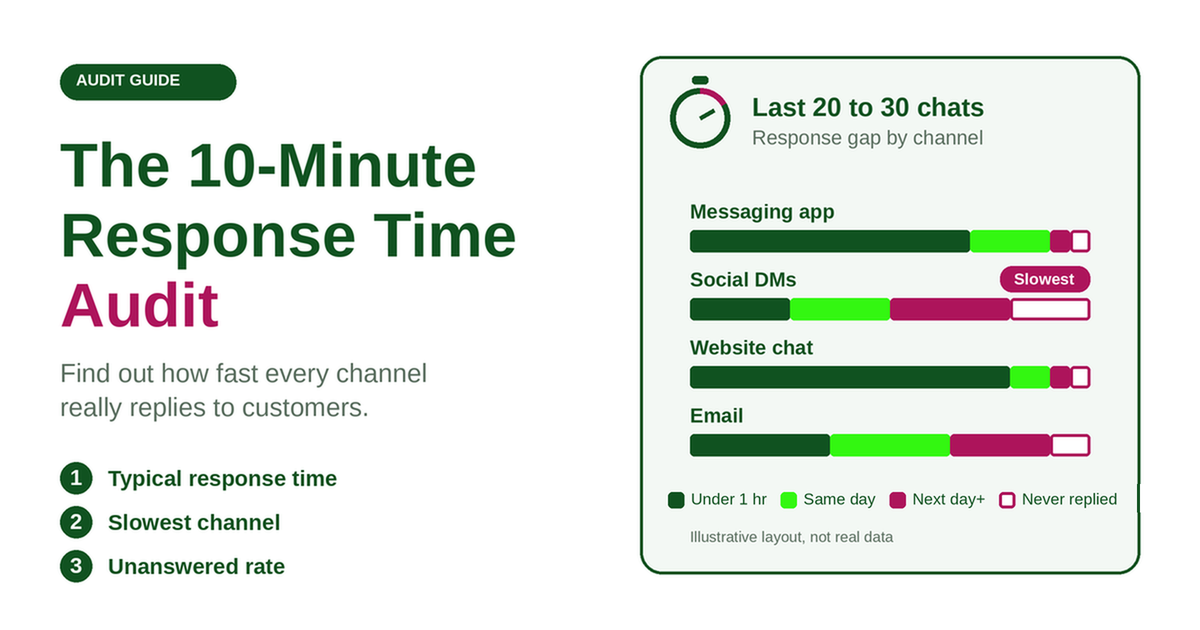
Most omnichannel business owners believe their team responds to customer messages quickly. Ask them directly and you will hear something confident: "We reply within an hour, usually faster." Then you ask them to prove it, and the confidence drains out of the room. Nobody has actually counted. The belief is built on the handful of fast replies they happen to remember, not on the slow ones that slipped through at 6pm on a Thursday.
Here is the uncomfortable part. The messages you forget are almost always the ones that cost you money. A quick reply feels normal, so it leaves no memory. A message that sat unanswered for nine hours, or never got answered at all, is invisible to the person who was supposed to answer it, because they never saw it in the first place.
So let's count. Not with expensive analytics software, not with a consultant, not with a dashboard you have to configure for a week. Just you, your phones and apps, a notepad or a spreadsheet, and about ten minutes. This is a response time audit you can run today, and I would bet money it tells you something you did not expect.
Why gut feeling is a terrible measurement
People are bad at estimating their own response times for the same reason they are bad at estimating how much they spend on coffee. The small, frequent events blur together and the memorable ones get overweighted.
When a customer messages you on Instagram and you reply in four minutes because you happened to be scrolling, that becomes your mental benchmark. "We're fast." But the WhatsApp message that came in while you were on a call, got buried under three others, and finally got answered the next morning? That one does not get filed under "slow." It gets filed under "forgotten," which is a different folder entirely, and it is the folder that matters.
The real problem with omnichannel business communication is not that any single channel is slow. It is that your attention is split across too many places, and the gaps between those places are where leads fall through. You can be genuinely fast on the channel you watch most and genuinely terrible on the two you check twice a day, and your overall impression will land somewhere in the middle, which is to say, nowhere accurate.
The audit fixes this by replacing your impression with numbers. Three numbers per channel, actually. Once you see them written down, you cannot un-see them, and that is the point.
What the audit measures
By the end of ten minutes you want three figures for each channel you use:
Typical response time. Not your best, not your worst, your median. How long did a customer usually wait before a human replied?
Your slowest channel. The one place where messages consistently wait the longest. Almost every business has one, and almost every business is wrong about which one it is.
Your unanswered-message rate. The percentage of inbound messages that never got a reply at all. This is the number that quietly bleeds revenue.
That is it. No fancy metrics, no "customer effort scores," no weighted averages. Three simple numbers that tell you where you are losing people.
The five-step audit
Set a timer if it helps. You are aiming for speed and honesty, not perfection.
Step 1: List your channels
Write down every place a customer can send you a message. Be ruthless and complete, because the channel you forget is often the leaky one.
A typical list looks like this: WhatsApp, Instagram DMs, Facebook Messenger, the website live chat, SMS, and plain old email. Some businesses add Telegram, a contact form that lands in a shared inbox, or a "chat with us" button nobody on the team remembers installing. If customers can reach you there, it goes on the list.
The reason this matters: you cannot audit a channel you have mentally written off. I have seen owners genuinely surprised to learn that the Facebook page they stopped posting on two years ago still receives three or four messages a week, all of them unanswered, some of them from people ready to buy.
Step 2: Pull your last 20 to 30 conversations per channel
Open each channel and scroll back through the most recent conversations. You do not need a huge sample. The last 20 to 30 messages per channel is plenty to spot a pattern, and it keeps the whole thing inside ten minutes.
Look at real inbound messages from customers or prospects, not internal chatter, not spam, not the automated "thanks for your order" confirmations. You want genuine human-to-human exchanges where someone asked something and expected a reply.
If a channel gets very little traffic, take whatever is there. Even five real conversations will tell you whether that channel is being watched or ignored.
Step 3: Clock the gap between their message and your first human reply
For each conversation, find the moment the customer's message arrived and the moment a real person answered. The difference is your response time for that exchange.
Two rules keep this honest. First, measure to the first human reply, not to an autoresponder. "Thanks, we'll get back to you soon" is not an answer, it is a placeholder, and customers know the difference. Second, ignore your own business hours for a moment and just record the raw elapsed time. You can account for overnight gaps later, but you want the unfiltered picture first, because customers do not pause their expectations because it is after six.
Jot the numbers down as you go. Four minutes.22 minutes. Three hours. Next day. Do not round them into comfortable ranges yet. Write the real figure.
By the time you have done one channel you will already feel the pattern forming. Keep moving.
Step 4: Find the median and flag the slowest channel
Now take the response times for each channel and find the middle value. The median matters more than the average here, because one message you answered at 2am to a friend who happened to be a customer will drag your average into fantasy territory. The median tells you what a normal customer normally experiences.
Line the channels up side by side. One of them will have a visibly worse median than the rest. That is your slowest channel, and it is usually a surprise. Owners expect email to be the slow one and it often is not, because email feels like "real work" and gets handled. The slow one is frequently a social DM that lives on a phone nobody owns, or a live chat that pings a browser tab left open on a laptop in the back office.
This is the step that changes minds. One channel can quietly drag down your whole omnichannel business without anyone noticing, because the people watching the fast channels assume everyone else is doing the same on theirs.
Step 5: Count the dead ends
Go back through your sample one more time and count how many inbound messages never received any reply at all. Not a slow reply. No reply. The conversation thread just stops on the customer's side.
Divide that by the total number of conversations you looked at and you have your unanswered-message rate. If you pulled 25 conversations and 4 of them went nowhere, that is 16 percent. Sit with that number for a second. Sixteen out of every hundred people who reached out to buy from you got silence.
Now connect it to timing, because speed and silence are the same problem wearing two outfits. There is a well-known idea in sales that the value of a lead decays fast once they reach out, and the research behind it is worth reading before you shrug off your slow numbers. The Harvard Business Review analysis on how quickly online sales leads go cold, documented in the Lead Response Management found that firms contacting leads within an hour were dramatically more likely to reach a meaningful conversation than those who waited longer. Read it before you publish your own excuses: a lead that waited a day for your reply was, for practical purposes, a different and much colder lead by the time you answered.
Your unanswered-message rate is just the extreme end of that curve. Those people did not go cold. They never got warmed up at all.
What an omnichannel business should do with these numbers
You now have three numbers per channel and probably a slightly sick feeling. Good. The feeling is useful. Here is how to act on it without overcorrecting.
Fix the slowest channel first, not the loudest. It is tempting to pour energy into the channel that generates the most noise, but the biggest gain comes from the channel that is quietly failing. If your Instagram median is four hours and everything else is twelve minutes, that four-hour gap is where your money is sitting. Assign one specific person to own that channel, and give them a target: every message answered within a defined window during business hours, no exceptions.
Attack the unanswered rate with structure, not willpower. You cannot "try harder" your way to zero dropped leads, and I want to be direct about why. This is almost never a motivation problem. Your team is not lazy and they are not ignoring customers on purpose. The message simply never crossed their field of attention. It arrived on a channel they were not looking at, in an app they do not have open, while they were handling something urgent somewhere else.
That distinction matters enormously, because the fix for a motivation problem is pressure, and the fix for an attention problem is design. Pressure applied to an attention problem just makes people anxious and no faster. You have to change where the messages land, not how guilty people feel about missing them.
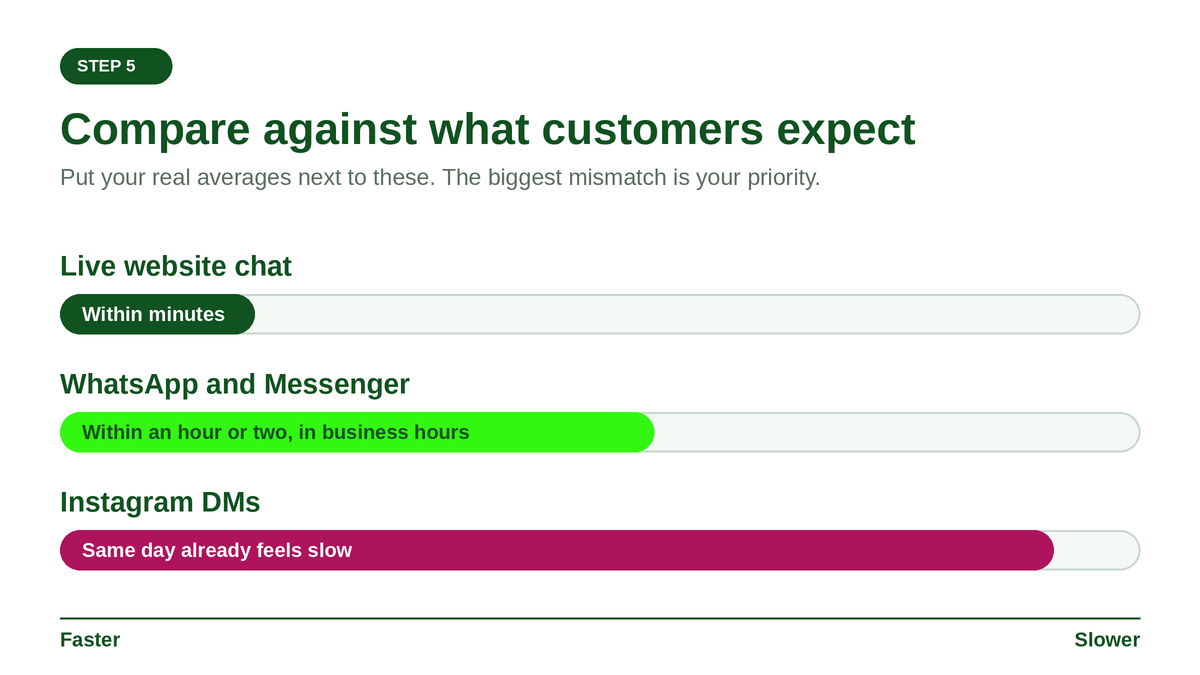
Set a response time standard everyone can see. Pick a number. "First human reply within 15 minutes during business hours" is a reasonable starting point for most small teams, and it is aggressive enough to matter without being impossible. Write it down. Share it. A standard that lives in your head is not a standard, it is a hope.
Rerun the audit. This is the part people skip and the part that actually works. A response time audit you run once is a moment of clarity that fades in a week. A response time audit you run monthly becomes a feedback loop, and feedback loops are how behavior actually changes. You will watch your slowest channel climb out of the basement and your unanswered rate fall toward zero, and you will know it is real because you measured it the same way twice.
The accountability piece nobody wants to talk about
Here is where team accountability gets delicate, and where a lot of owners get it wrong.
When the audit reveals a bad number, the instinct is to find out who dropped the ball. That instinct feels like leadership. It is actually the fastest way to make sure nobody tells you the truth next month. The moment the audit becomes a tool for blame, people start quietly answering only the messages that are easy to track and avoiding the channels that make them look slow.
Accountability works when it is attached to a shared system, not a scapegoat. "Whose fault was this message" is the wrong question. "Where did this message live, and why did none of us see it" is the right one. Nine times out of ten the honest answer is that it lived somewhere no single person was responsible for, which is not a people failure, it is a structure failure.
When someone misses a message because it was on a channel nobody owns, that is a design flaw you created, not a crime they committed. Fix the design. Assign clear ownership of every channel. Make it obvious at a glance which messages are still waiting and who is on the hook for them. Do that, and accountability stops being a stick and starts being something the team can actually act on.
The businesses that get this right tend to share one habit. They stopped treating fast replies as a personal virtue and started treating them as an operational outcome, something the system produces reliably whether or not anyone is feeling heroic that day.
Why the problem compounds as you add channels
A single-channel business rarely has a response time crisis. One inbox, one place to look, one habit to build. The person checks it, replies, moves on. Easy.
The trouble starts the moment you add a second channel, and it is not linear. Two channels are more than twice as hard as one, because now there is a gap between them, and gaps are where attention leaks. Add a third and a fourth and you are not running one inbox, you are running four, each with its own login, its own notification style, its own rhythm. Nobody can hold four live conversations in four separate apps and stay fast on all of them. The human attention span simply does not stretch that far.
This is the mechanical reason omnichannel business communication tends to produce slower response times than any single channel would on its own. The messages are not slower to answer. They are slower to find. Every switch between apps carries a small cost in attention, and across a busy day those costs add up to hours of latency that nobody chose and nobody noticed.
When running an omnichannel business means juggling four separate apps, the realistic fix is to stop juggling. Pull every channel into one place so there is a single stream of conversations to watch and a single definition of "answered." That is the entire argument for a unified inbox for customer chats with Vira: it removes the gaps between channels, which is the same as removing the places where leads disappear. I have written about how this works in practice in 5 Channels, One Inbox: A Practical Guide to Omnichannel Messaging, and about why speed decides who wins the deal in Why Your Best Leads Keep Going to Whoever Answers Fastest.
You do not have to adopt any particular tool to benefit from the audit, to be clear. The audit works with pen and paper. But once you see your numbers, you will understand why consolidating your channels is the structural answer to a structural problem, and why trying to solve it with reminders and good intentions keeps failing.
A realistic picture of what good looks like
Let me give you a target to aim at, because "faster" is not a goal, it is a direction.
A small team running a healthy omnichannel omnichannel business operation usually lands somewhere like this. Median first-reply under 15 minutes during business hours across every channel, not just the favorites. A slowest channel that is slower than the rest by minutes, not hours. And an unanswered rate under 2 percent, with the rare miss being something genuinely edge-case, like a message that arrived at 11pm from a different time zone.
Compare that to where most businesses actually start: a fast channel at four minutes, a forgotten channel at six hours, and an unanswered rate somewhere between 10 and 20 percent that the owner would have sworn was near zero. The distance between those two pictures is not talent and it is not effort. It is attention, structured properly.
The first time you run this audit, you are measuring reality. The real value comes from the gap between what you believed and what you found, because that gap is a map of exactly where your business is losing people, drawn in numbers you can actually do something about.
Save this audit and run it again next month to keep your omnichannel business honest about response times. The number you get in thirty days, measured the same way, will tell you whether anything you changed actually worked, and that honest comparison is worth more than any dashboard you could buy.