
October 30, 2026 · CHARITY
Customer Support Scorecard: Rate Your Team’s Response
Customer support scorecard: score your team on response speed, ownership and coverage in five questions, then see which gap costs you customers.
A customer messages your brand on Instagram at 9am, follows up on WhatsApp by lunch, then fires off an email when nobody replies by the end of the day. By the time your customer support team catches up, three different agents have answered three different channels, nobody knows who actually owns the thread, and the customer has to tell the whole story again from scratch. This post hands you a customer support scorecard so you can measure exactly where that breakdown happens instead of just feeling it.
Most support leads sense something is off. Replies feel slow. Customers sound annoyed. Agents look busy but swamped. What they rarely have is a clean way to put a number on the gap. That is what the scorecard below is for.
Published October 30, 2026. Updated October 30, 2026.
What Is a Customer Support Scorecard?
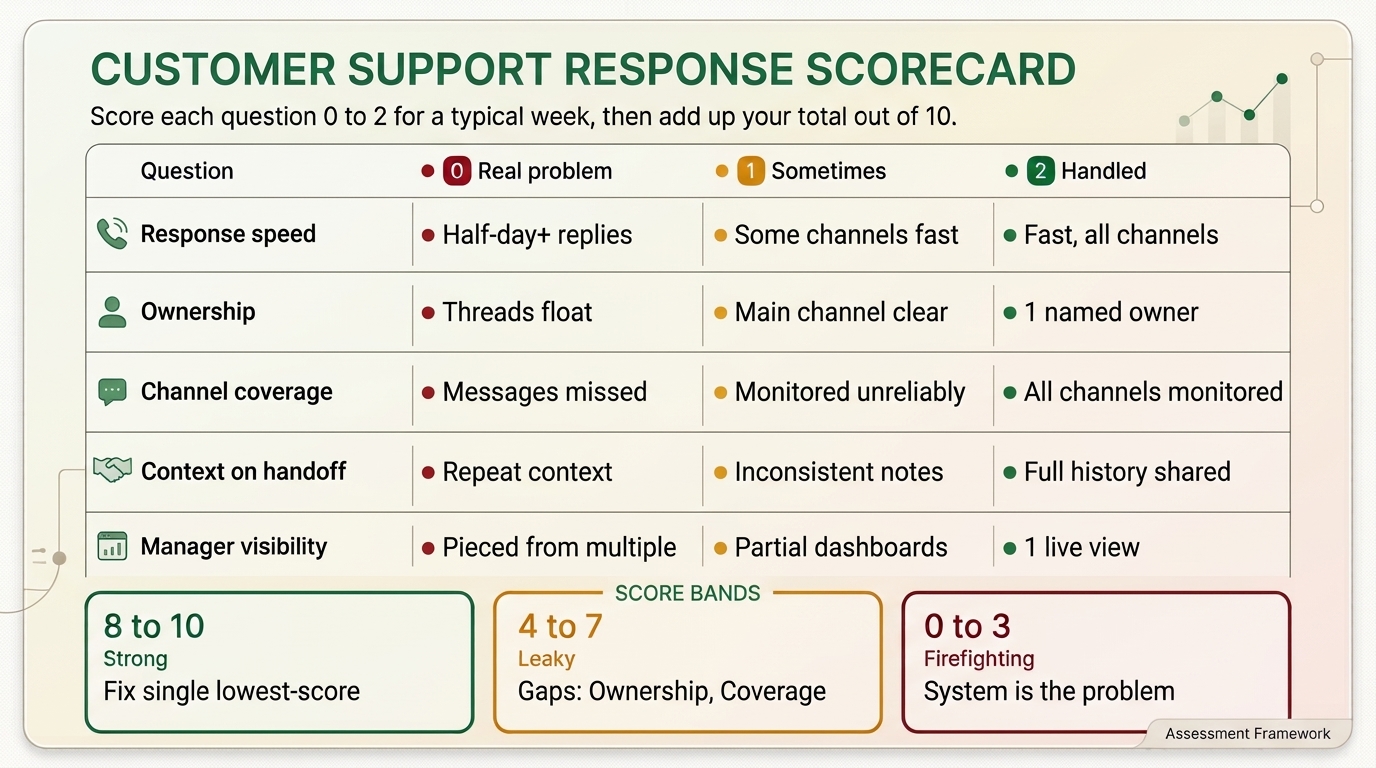
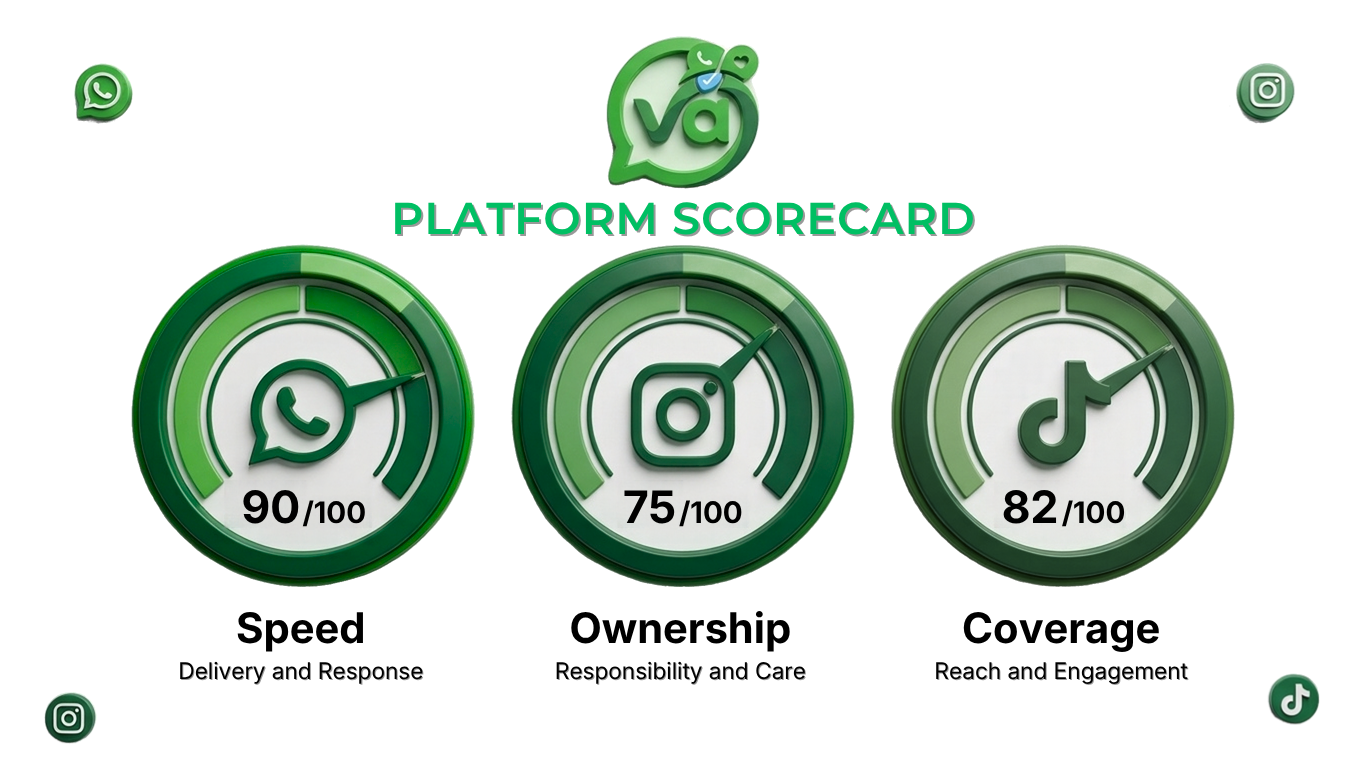
A customer support scorecard is a short, repeatable check that rates your team on three things: how fast you respond, who owns each conversation, and whether every channel is covered. You answer five questions, tally the result, and get a clear read on where replies slip through the cracks. It turns a vague feeling of "we're falling behind" into a specific gap you can fix.
The point is not to grade people for the sake of it. The point is to find the one weak spot that is quietly costing you the most, then do something about it.
How Slow Replies Quietly Hurt Your Business
Slow replies rarely cause a dramatic blowup. They bleed you slowly.
When a customer has to repeat the same question across channels, resolution time stretches. A query that should take one exchange now takes four, because each agent starts cold. Your support team spends its energy re-reading history instead of solving the actual problem.
There is a cost to the customer side too. Harvard Business Review's research on customer effort found that the single biggest driver of disloyalty is making people work too hard to get an answer. Every repeated explanation, every "let me transfer you," every channel switch adds to that effort score. You might be answering every message and still losing goodwill because the path to resolution feels like a chore.
Then there is the invisible workload. A WhatsApp thread sitting unanswered doesn't show up in the same place as an overflowing email inbox. Agents feel buried, but the manager can't see the full picture because the work is scattered across five apps. People burn out faster when nobody can even see how much they're carrying.
How Unowned Conversations Turn Into Lost Customers
Slow is bad. Unowned is worse.
When no single agent owns a conversation, it falls into a gap where everyone assumes someone else has it. The customer waits. Then they stop waiting.
Here is an illustrative example. A shopper asks about a return policy on Instagram, gets a half-answer, then messages WhatsApp to confirm. Agent one thinks agent two has it. Agent two thinks the Instagram reply closed it. Nobody follows up. Two days later the shopper requests a refund and buys from a competitor who answered in minutes. One cooled lead, one lost sale, and a small dent in your reputation when they mention it to a friend.
Multiply that across a week. The cancellations, the abandoned carts, the leads that go quiet: a lot of them trace back to a single conversation that nobody claimed. Good customer service isn't only about speed. It's about accountability. A fast reply from the wrong person who then drops the ball can be worse than a slightly slower reply that actually gets owned end to end.
The Customer Support Response Scorecard: Five Questions
Here is the customer support response scorecard. Answer each question honestly for a typical week, not your best day. Score each one from 0 to 2, where 0 means "this is a real problem," 1 means "sometimes," and 2 means "we've got this handled."
1. Response speed. When a customer messages during working hours, do you consistently reply within your target time (say, under an hour)?
0: Replies regularly take half a day or more.
1: Fast on some channels, slow on others.
2: Predictable, fast first response across the board.
2. Ownership. When a conversation comes in, is it immediately clear which agent owns it until it's resolved?
0: Threads float. Anyone might grab them, or nobody does.
1: Ownership is clear on your main channel but fuzzy elsewhere.
2: Every conversation has one named owner, every time.
3. Channel coverage. Are you confident no message on any channel is sitting unseen right now?
0: You've definitely missed messages on at least one channel.
1: You check everything eventually, but not on a reliable rhythm.
2: Every channel is monitored continuously, nothing goes dark.
4. Context on handoff. When a conversation passes between agents or channels, does the next person see the full history?
0: Customers have to repeat themselves constantly.
1: Some notes get passed along, inconsistently.
2: Full history travels with the conversation automatically.
5. Visibility for the manager. Can you, as the lead, see your whole team's live workload and backlog in one view?
0: You piece it together by asking people.
1: Partial dashboards, lots of guessing.
2: One screen shows everything, in real time.
Add up your score.
8 to 10: Strong. Your weak spot is the single question you scored lowest on. Fix that one.
4 to 7: Leaky. You're losing customers in the gaps, probably on ownership and coverage.
0 to 3: Firefighting. Your team is working hard inside a broken setup. The system, not the people, is the problem.
Most teams who run this honestly land in the middle band. And almost all of them lose the most points on questions two and three: ownership and coverage. That's the tell.
Why the Same Two Gaps Keep Showing Up
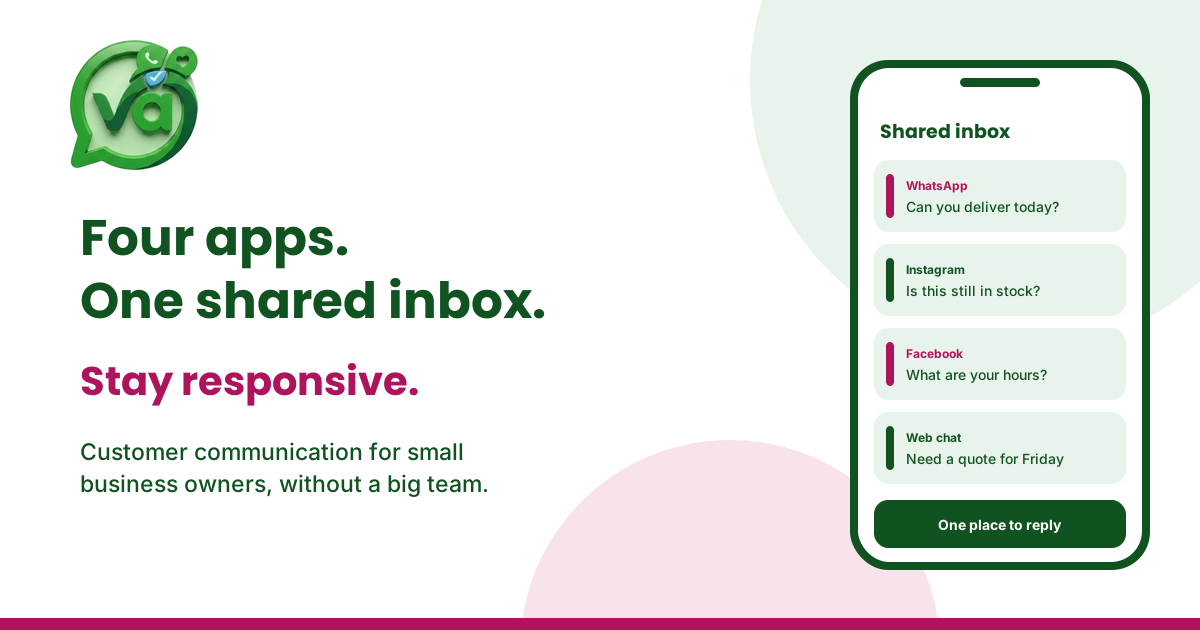
Ownership and coverage both fail for the same reason: your conversations live in too many separate places. Instagram in one app, WhatsApp in another, email in a third, live chat in a fourth. When each channel is its own island, there is no shared view of who's handling what, and there's no way to guarantee every island is being watched.
A unified inbox fixes the root cause. When every message from every channel lands in one place, ownership becomes simple: you assign a thread to one agent and it stays with them. Coverage becomes simple too, because there is a single queue to watch instead of five apps to juggle. Omnichannel communication stops meaning "five tools five logins" and starts meaning "one conversation, whatever channel it came from."
That's the difference between telling the story of a problem and actually closing it. The handoff question on the scorecard sorts itself out when full history travels with the thread. The manager visibility question sorts itself out when the backlog sits in one screen. Score question one on speed improves almost by default, because agents stop wasting minutes hunting for context before they can even reply.
If your team scored low on ownership or coverage, don't try to fix it with more rules and reminders. Fix it with a setup where those gaps can't open in the first place.
Run the Scorecard, Then Close the Biggest Gap
Score your team this week, then look at your lowest number. That's where your customer support is leaking customers, and it's where a unified inbox like Vira.chat earns its keep by pulling every channel into one owned, visible queue. Start a free trial, bring your real conversations in, and re-run the scorecard in two weeks to see the gap close for yourself.
Frequently Asked Questions
How often should I run the customer support scorecard?
Monthly is a good rhythm. Run it once to get your baseline, fix the lowest-scoring area, then re-run it four weeks later to confirm the change actually stuck. Quarterly is the minimum if your volume is steady.
What score should my team be aiming for?
Anything consistently at 8 or above means you're in good shape. The goal isn't a perfect 10 on your best day. It's a reliable high score on an ordinary, busy Tuesday.
Does this work for a small team of two or three agents?
Yes, and arguably it matters more. With a small team, one dropped conversation is a bigger share of your week, and ownership confusion happens fast when the same two people cover every channel.
My speed is fine but ownership is weak. Where do I start?
Start with a single shared queue where every thread gets assigned to one named person. Ownership problems almost always come from scattered channels, not from agents who don't care.
The scorecard takes five minutes. The customers you keep by acting on it are worth a great deal more than that.