
November 5, 2026 · CHARITY
Customer Communication for Small Business: One Shared Inbox
Customer communication for small business owners: reply to WhatsApp, Instagram, Facebook and web chat from one shared inbox. Try Vira free for 14 days.
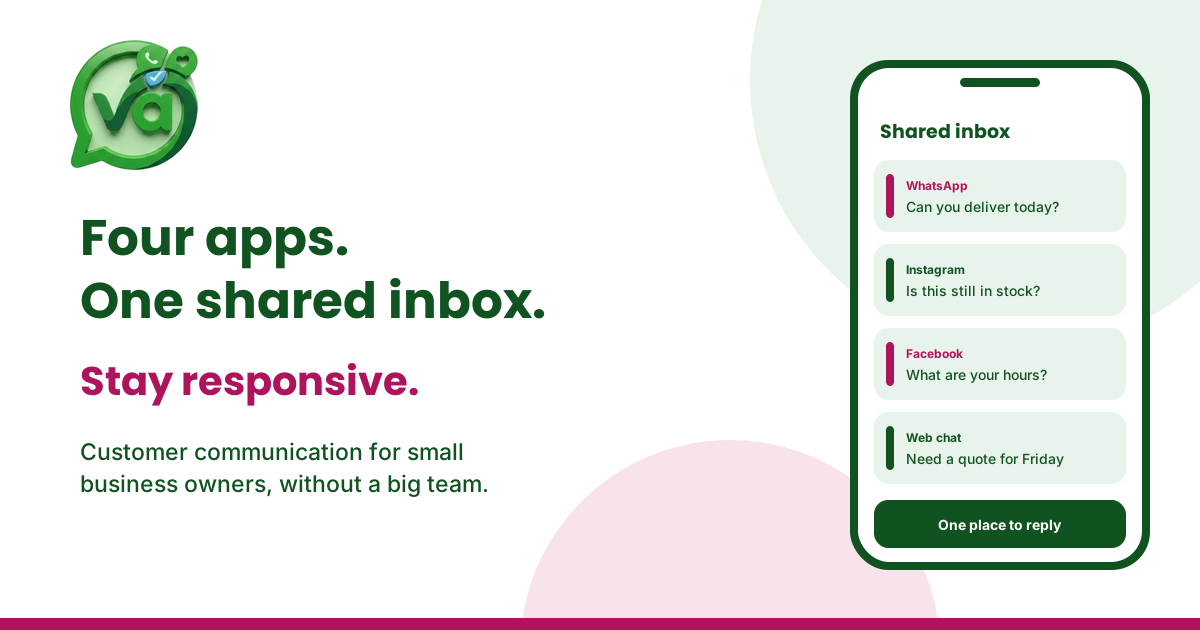
It's a Tuesday afternoon. You're halfway up a ladder fixing a client's gutter, or elbow-deep in an order, or driving between two appointments. Your phone buzzes. Then it buzzes again. WhatsApp, Instagram, and Facebook have all pinged within the same minute, and each one is a potential sale. By the time you climb down, wipe your hands, and open all three apps, one of those people has already messaged someone else. That's the quiet problem with customer communication when you run a small business: you're not losing because your prices are wrong or your work is poor. You're losing because you couldn't get to the message in time.
This isn't a story about hiring a support team. Most small business owners don't have one, and don't want one. It's about having a single place to reply, so the apps stop running your day.
Why customer communication breaks down for small business owners
Here's the honest version of what happens. Your customers write wherever they feel like writing. Some people live on WhatsApp. Some only ever DM on Instagram. Older clients still message your Facebook page, and a few leave a note through the chat widget on your website. You didn't choose this spread. They did.
And you're the whole team. You're sales, you're support, you're the person who actually does the work. Customer communication for a small business owner means juggling four or five separate apps, each with its own notification sound, its own message history, and its own sneaky way of marking something as read before you've actually dealt with it.
The failure points stack up fast:
A message slips below the fold on Instagram and you forget it existed until two days later.
You reply on WhatsApp but can't remember whether this is the same person who asked about delivery on Facebook last week.
You're on your laptop, but the chat you need is only on your phone, which is charging in the other room.
A family member or part-timer helps out for an afternoon, but they can't see any of the conversations, so they end up asking the customer things you already answered.
None of these are dramatic on their own. Together, they make you look slower and less organised than you actually are. Response time is one of the few things customers notice immediately, and research on buyer behaviour has long shown that the first business to reply often wins the deal. Harvard Business Review's well-known study on lead response times found that companies replying within an hour were dramatically more likely to qualify a lead than those who waited even a little longer. For a small operation, "an hour" can quietly stretch into "tomorrow" without anyone deciding it should.
What is customer communication for a small business?
Strip away the jargon and it's simple. Customer communication for a small business is every back-and-forth you have with someone who might buy from you or already has: the question about price, the "are you open Saturday," the order confirmation, the follow-up after the job's done. It happens across whatever channels your customers prefer, and it usually lands on one person, you.
What makes it different from a big company's setup is scale and tooling. A large brand has a department, shift rotas, and expensive software. You have your phone and whatever free time exists between tasks. So the goal isn't to copy how enterprises do support. The goal is to remove the friction that's unique to being small: too many apps, no shared history, and messages arriving when your hands are full.
The fix most owners stumble into eventually is a shared inbox. One screen where every conversation shows up, no matter which platform it came in on.
How one shared inbox changes the day
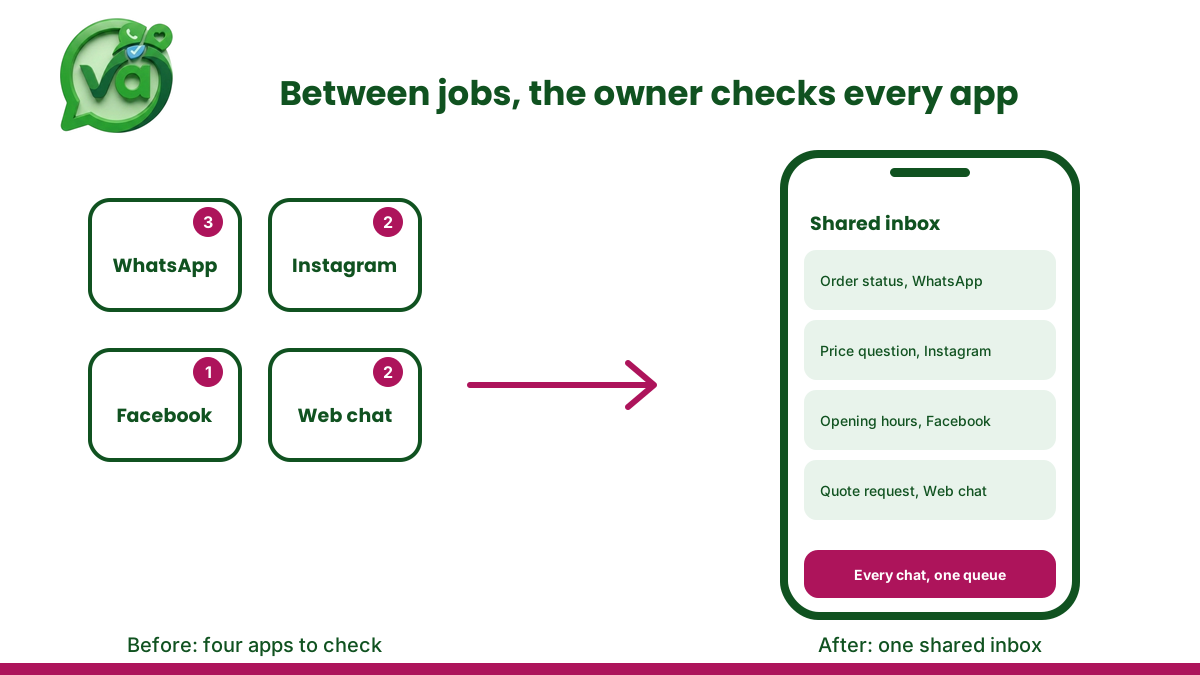
Picture the same Tuesday, but your WhatsApp, Instagram, Facebook Messenger, and website chat all feed into a single unified inbox. The ladder scenario doesn't disappear, but now when you come down, you open one app instead of four. Every unread message is in one list. You can see at a glance which ones need a reply and which can wait.
The difference is bigger than tidiness. When all your channels sit together, you stop treating each platform as a separate little world. You see that the person asking about pricing on Instagram is the same name who enquired on your website last Thursday. You reply once, in context, and move on. That continuity is what makes customer communication feel professional even when it's just you behind it.
A few things change in practice:
You reply from a laptop or a phone, interchangeably. The conversation lives in the inbox, not trapped on one device. Start a reply on your computer in the morning, finish it from your phone at lunch.
You can let someone help without handing over your passwords. If your sister covers the shop on Saturdays, or you bring on a part-time assistant, they log into the shared inbox and see the full history. No forwarded screenshots. No "wait, what did you already tell them?"
You stop losing messages to the gaps between apps. When everything surfaces in one place, the "I forgot that Instagram DM" problem mostly goes away, because there's no separate Instagram tab to forget.
This is where tools like Vira earn their keep. Vira pulls your WhatsApp Business, Instagram messages, Facebook Messenger, and web chat into one shared inbox, so a small business owner isn't bouncing between apps to keep up. The point isn't fancy features. It's getting your customer communication down to a single, calm screen you can actually keep on top of.
What about the messages you can't get to in time?
Even with everything in one place, you're still human. You'll be on a job, asleep, or just busy. This is where a bit of automation helps without making you feel like a robot is pretending to be you.
An AI auto-reply can hold the line while you're unavailable. Someone messages at 9pm asking if you deliver, and instead of silence until morning, they get an instant, accurate answer pulled from how you've set it up. You still take over the real conversation when you're free, but the customer never feels ignored. For a lot of small businesses, that immediate first response is the whole difference between a booked job and a cold trail.
Set it up for the questions you answer constantly: opening hours, location, basic pricing, whether you take a particular payment method. Those are the messages eating your evenings. Let the auto-reply handle the routine, and save your actual attention for the conversations that need a human.
A realistic way to start
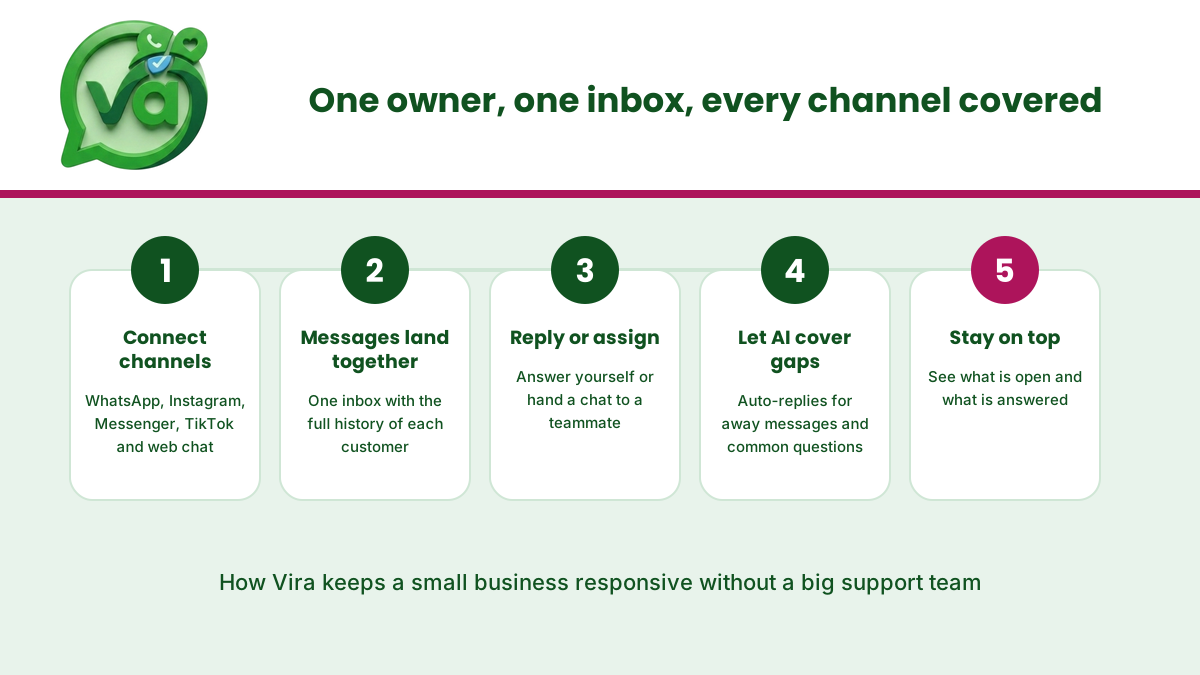
You don't need to overhaul anything. Pick the channel that generates the most messages, usually WhatsApp for most small businesses, and route it into a single inbox first. Add the others once it feels natural. Within a week you'll notice you're checking fewer apps and missing fewer messages, and that's really the whole win.
The mistake I'd steer you away from is waiting until you're "big enough" to bother. The crunch of scattered customer communication hits hardest when you're small, because every lost message is a bigger slice of your week. Fixing it early is cheaper than fixing it after you've lost a month of enquiries you never even saw.
Start a free 14-day trial of simpler customer communication
If juggling apps has started to feel like a second job, give the one-inbox approach a proper go before you decide. Vira lets you bring WhatsApp, Instagram, Facebook, and web chat into one shared inbox, with AI auto-replies for the moments you can't answer yourself.
Register for the free 14-day trial and see how much lighter your customer communication feels when every message lands in one place.