
October 9, 2026 · CHARITY
Multi-Channel Communication Myths vs Facts for Teams
Multi-channel communication myths vs facts: see what really slows teams down and how one shared inbox keeps every customer message owned and answered.
Multi-channel communication sounds like an advantage until a customer writes on two apps and nobody owns the reply. A message lands on Instagram, then the same person follows up by email twenty minutes later, and by the time anyone notices, they've asked a third time and started tapping their foot.
This is the gap between how multi-channel communication looks on a pitch deck and how it actually behaves at 4pm on a busy Tuesday. The appeal is real. More places to reach people usually sounds like more sales and happier customers. But a lot of what teams believe about running several channels is half true at best, and the half that's wrong tends to cost you the exact customers you worked hardest to win.
So let's pull apart the common assumptions, one myth at a time. And there's a quick poll further down, because I'm genuinely curious how your setup compares to everyone else reading this.
Why channels keep multiplying
A bit of context first. As of April 2026, Data Reportal's Digital 2026 Mid-Year Global Update counted 5.79 billion social media user identities worldwide. People don't live inside one app anymore. They drift between WhatsApp, Instagram, a web chat widget, email, and whatever messaging thread their last order confirmation arrived in.
Your customers aren't being difficult. They're using whatever is open on their phone. That's the reality every support lead and small team owner has to design around, and it's why the myths below get people into trouble.
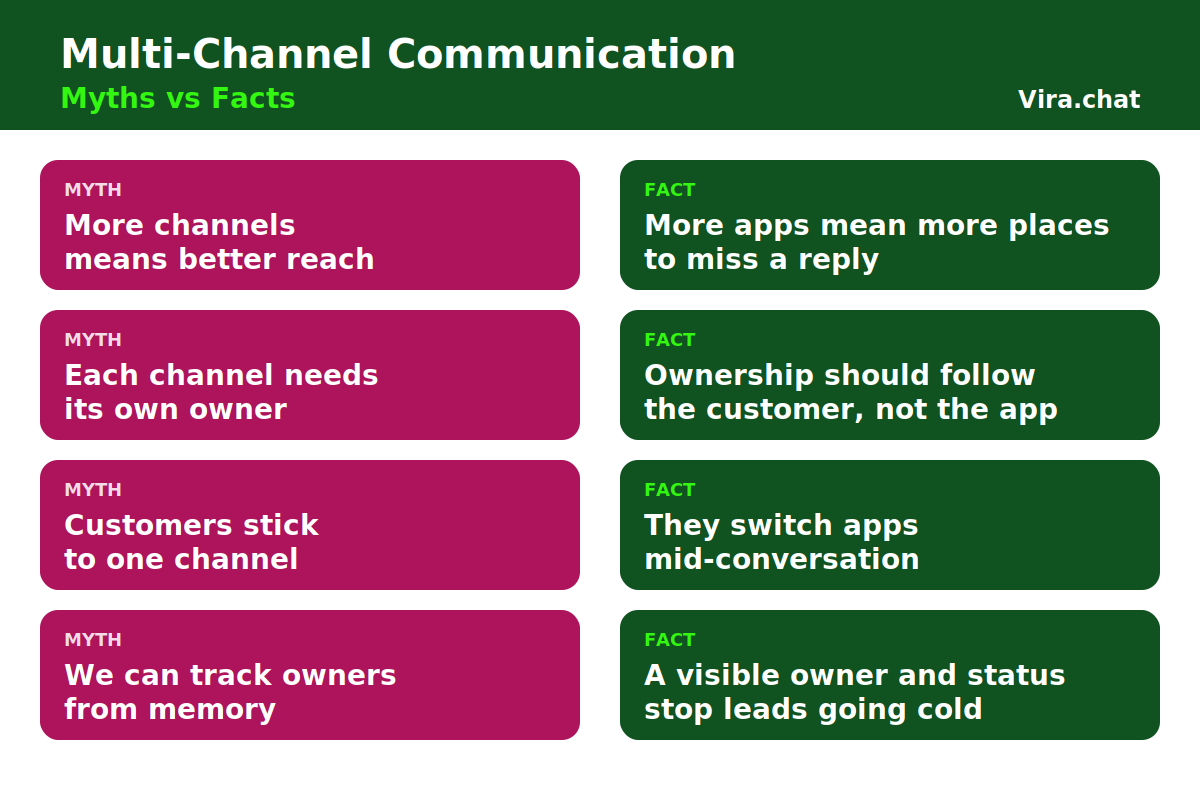
Multi-Channel Communication Myth 1: More Channels Means Better Reach
The logic feels airtight. Add WhatsApp, add Messenger, add email, add a chat widget, and you've widened the net. More doors, more customers walking through them.
Here's what actually happens. Each new channel is another place a reply can go unseen. If those channels don't feed into one shared view, your reach didn't grow, your blind spots did. A team of three adding a fourth channel doesn't get four times the coverage. It gets four separate tabs, each quietly accumulating messages someone assumed a colleague was handling.
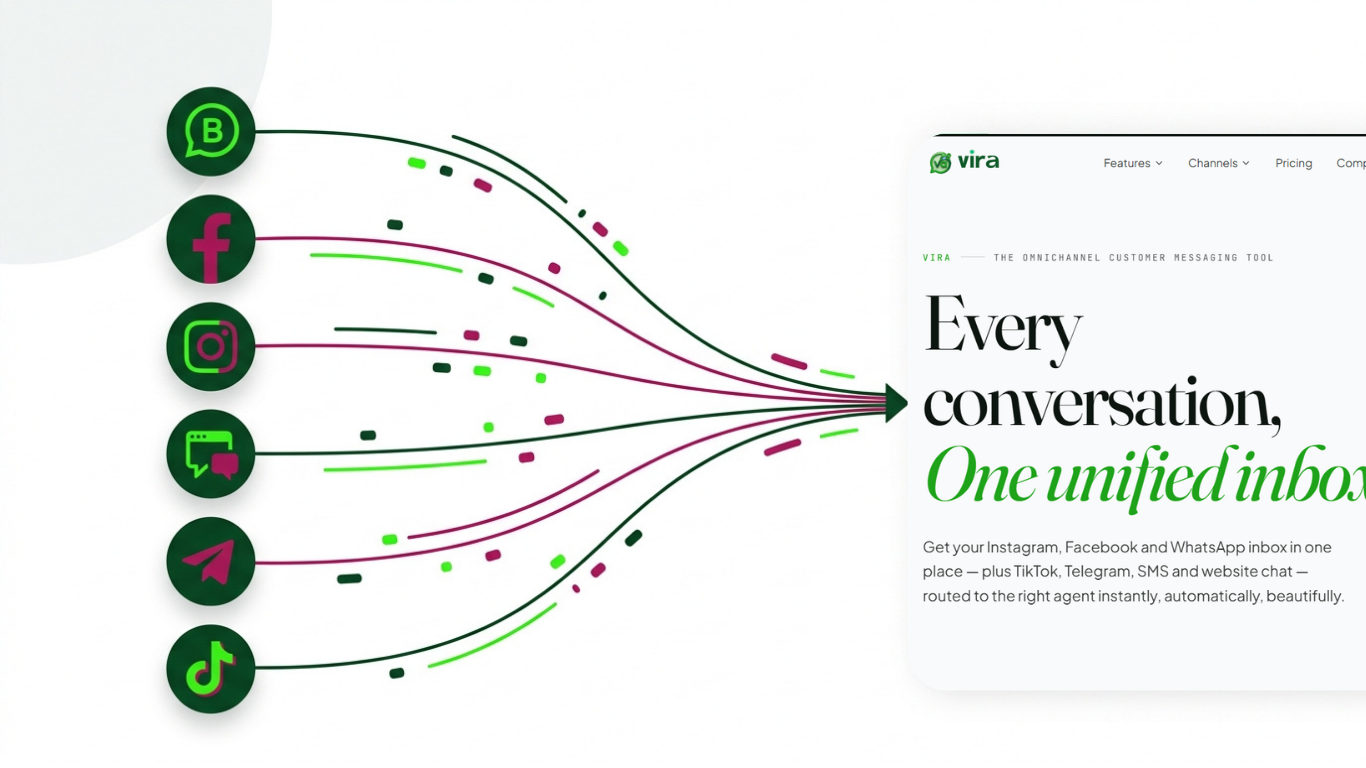
Reach is only an asset when every incoming message is visible in one place and someone is clearly accountable for it. Without that, more channels just means more ways to disappoint people faster. That's the whole case for a unified inbox that fixes scattered messages instead of adding yet another app to the pile.
Myth 2: Each Channel Needs Its Own Person or App
This one sounds organized. Mariam handles Instagram, Daniel handles email, someone else watches WhatsApp. Tidy on paper.
The problem is that customer messaging doesn't respect your org chart. Daniel takes a day off and his inbox sits there. Mariam gets slammed during a promotion and the email queue grows because nobody's cross-trained. You've built a system where coverage depends on specific people being at specific screens at specific times.
What actually matters isn't where the message arrives. It's whether someone owns it. A message on your chat widget and a message on WhatsApp carry the same promise to the customer: a human will respond. The channel is a detail. Ownership is the thing. Once you separate those two ideas, you stop needing a dedicated person per app and start needing a clear answer to who owns each customer chat.
Myth 3: Customers Stick to One Channel
If only. In practice a single conversation can hop across three places before it's resolved.
Picture this. Someone DMs you on Instagram asking about a delayed order. You reply, they don't see the notification, so they send an email that evening. The next morning they're frustrated and fire off a WhatsApp message to the number on their receipt. Same person, same issue, three threads, and three different team members each seeing only one piece of it.
To the customer, this is one conversation. To your team, it looks like three separate strangers with vaguely similar complaints. Someone apologizes for a delay that was already explained. Someone else asks for an order number that was already shared. The customer concludes, reasonably, that nobody's listening.
The fix isn't training people to guess which channel someone prefers. It's making sure that when a person switches mid-conversation, their history follows them. Business messaging that scatters across platforms without a connecting thread turns one annoyed customer into three unresolved tickets.
Myth 4: The Team Can Track Who Owns What From Memory
For a while, this genuinely works. When you're doing twenty messages a day across two channels, you can keep it all in your head. A quick "did you reply to the Instagram one?" across the room sorts it out.
Then volume climbs. Twenty becomes eighty. Two channels become four. The verbal check-ins stop being reliable because now there are too many open threads and too many assumptions. The dropped messages are rarely the loud ones. They're the quiet replies that were almost closed, the follow-up that needed one more answer, the person who said "thanks, one last thing" and got silence.
Memory is a lovely system until it isn't, and you usually find out at the worst possible moment: a refund request that aged out, a hot lead who went cold, a review that mentions being ignored. Scaling a team on memory is scaling on luck.
Quick poll: how many apps does your team check?
Before you read the takeaway, be honest for a second. Pick the one that matches your current setup.
How many apps does your team check for customer messages?
1 app: everything funnels into a single place
2 to 3 apps: manageable, but you're switching tabs
4 or more apps: you're spending real time just hunting for messages
If you landed on "2 to 3," you're where most small teams sit, and it's the stage where things still feel fine but the cracks are starting. If you picked "4 or more," you already feel the drag of it, you just might not have added up the hours lost to the hunt.
The pattern behind all four myths
Notice what every myth has in common. Each one treats the channel itself as the thing that matters: which app, which person, which platform. The fact underneath all of them is the same. The channel is almost irrelevant. What matters is whether every message, no matter where it lands, shows up in one view with one clear owner.
That's the entire argument for pulling your channels together rather than managing them in parallel. When multi-channel communication runs through a single shared workspace, adding a channel genuinely does expand your reach, because there's no new blind spot attached to it. The customer who jumps from Instagram to email to WhatsApp stays one conversation. Coverage stops depending on who happens to be watching which tab.
It's a quieter kind of win than "we added three new channels this quarter," but it's the one that keeps customers from writing that one-star review about being ignored.
Where to go from here
If you're running more than two channels and relying on people to remember who's handling what, the next outage isn't a matter of if. It's a matter of when your busiest day collides with someone's day off. Tools like Vira.chat exist to collapse those scattered channels into one inbox, but the principle holds no matter what you use: one view, clear ownership, shared history.
Multi-channel communication isn't a numbers game. It's an ownership game dressed up as a numbers game, and the teams that figure that out early are the ones who scale without the chaos.
Vote in the poll above, and tag someone whose team juggles too many apps.