
October 26, 2026 · CHARITY
Multi-Channel Communication Gaps That Lose Customers
Multi-channel communication gaps open when messages arrive overnight or across timezones. See where replies get lost and how one shared queue closes them.
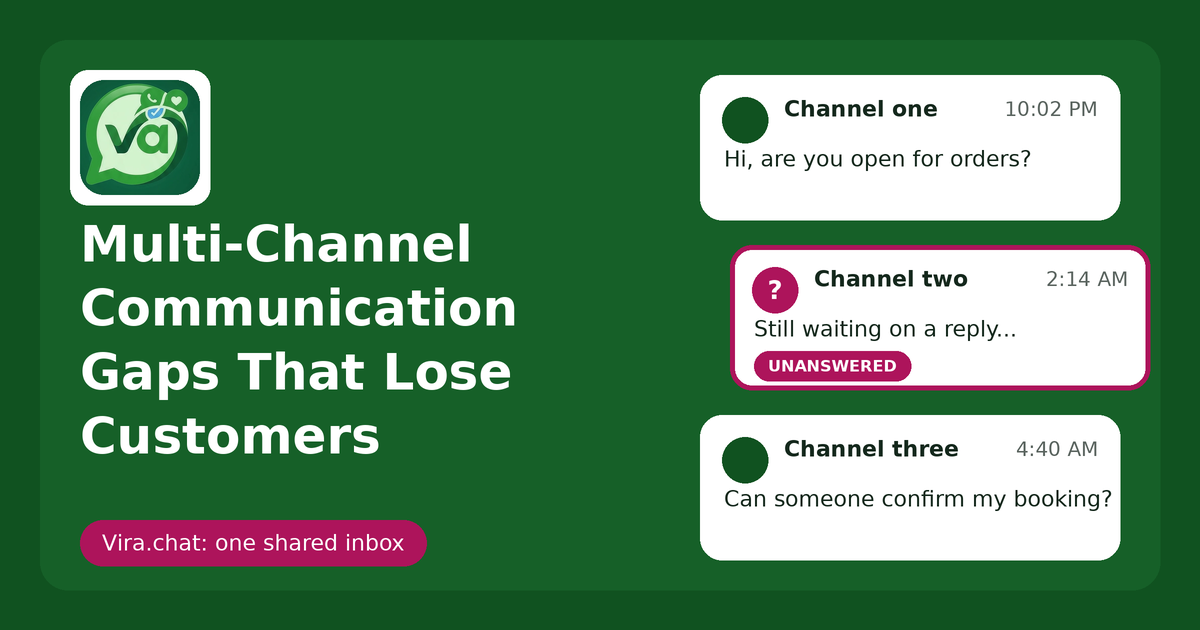
A customer in Berlin messages your Instagram at 11:40 PM their time. Someone in Sydney fires off a WhatsApp question while your support team is asleep. By the time anyone opens the app, both messages are eight hours cold — and the second one is sitting dangerously close to a reply window that's about to close. You didn't lose these customers because your product was wrong. You lost them because nobody saw the message in time.
That's the quiet failure mode of multi-channel communication. It isn't that you lack channels. You have too many, and each one keeps its own hours, its own notifications, and its own blind spots. The message arrives. It just doesn't arrive anywhere a human is looking.
Where Multi-Channel Communication Breaks Across Timezones
The gap opens whenever the person sending a message and the person meant to answer it are awake at different times. Customer support across timezones isn't a special case anymore — it's the default for anyone selling online. You can be a three-person team in one city and still have buyers in six countries.
Here's the mechanical problem. Each channel pushes notifications to whoever happens to have that app logged in. WhatsApp pings a phone. Instagram DMs land in a social manager's feed. Email sits in a shared mailbox nobody checks at night. Facebook Messenger routes to yet another person. There's no single place where all of this converges, so coverage is accidental rather than designed.
During your working hours, this chaos mostly hides itself. Somebody is online, replies land within minutes, and the cracks don't show. The trouble is strictly a timing problem. The moment incoming messages outrun your waking hours, every channel becomes a separate holding pen with no one watching the gate.
And customers don't grade you on effort. A buyer who waits fourteen hours for a reply has already opened a competitor's chat, usually within the first hour of silence.
Why Separate Apps Hide Overnight Messages
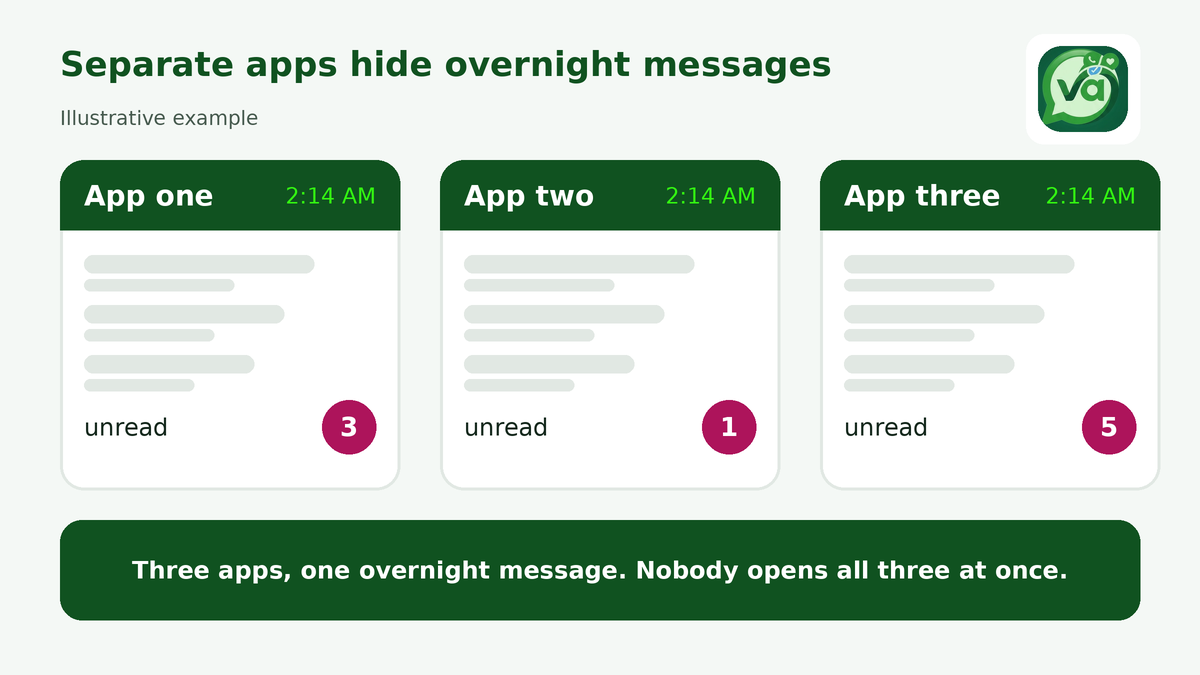
Think about what actually happens to an after-hours customer message when it lands in an isolated app.
First, it's invisible to the team. If the message came in on a channel that only one colleague monitors, and that colleague is offline, it may as well not exist until they wake up. There's no backup set of eyes, because there's no shared view.
Second, there's no record of ownership. When morning comes and three people open three different apps, nobody knows what's been handled. Two people might reply to the same customer. Or — far more common — everyone assumes someone else has it, and nothing gets answered at all. Diffusion of responsibility doesn't need a committee. Two apps and two sleepy humans will do it.
Third, the clock keeps running in ways you can't see. On WhatsApp specifically, a free-form reply is only possible within a set period after the customer last messages you. Meta's own documentation describes it plainly: the window opens when a user messages your business, runs for 24 hours, and resets each time they send a new message. Miss that window and you can no longer send a normal reply — you're pushed into template messages, which feel stiff and often need approval you don't have ready at 6 AM.
I won't rehash the full rules here — we covered the 24-hour response rule in detail in a previous post. The point for this discussion is narrower. The closing WhatsApp 24-hour window is a symptom of the real disease. The disease is that nobody could see the message while there was still time to answer it the easy way.
When your tools scatter conversations, every one of these failures compounds overnight. You wake up to a backlog, a few duplicate replies, and at least one customer who's now outside the free-reply window and feels ignored on top of it.
What a Shared Queue Changes
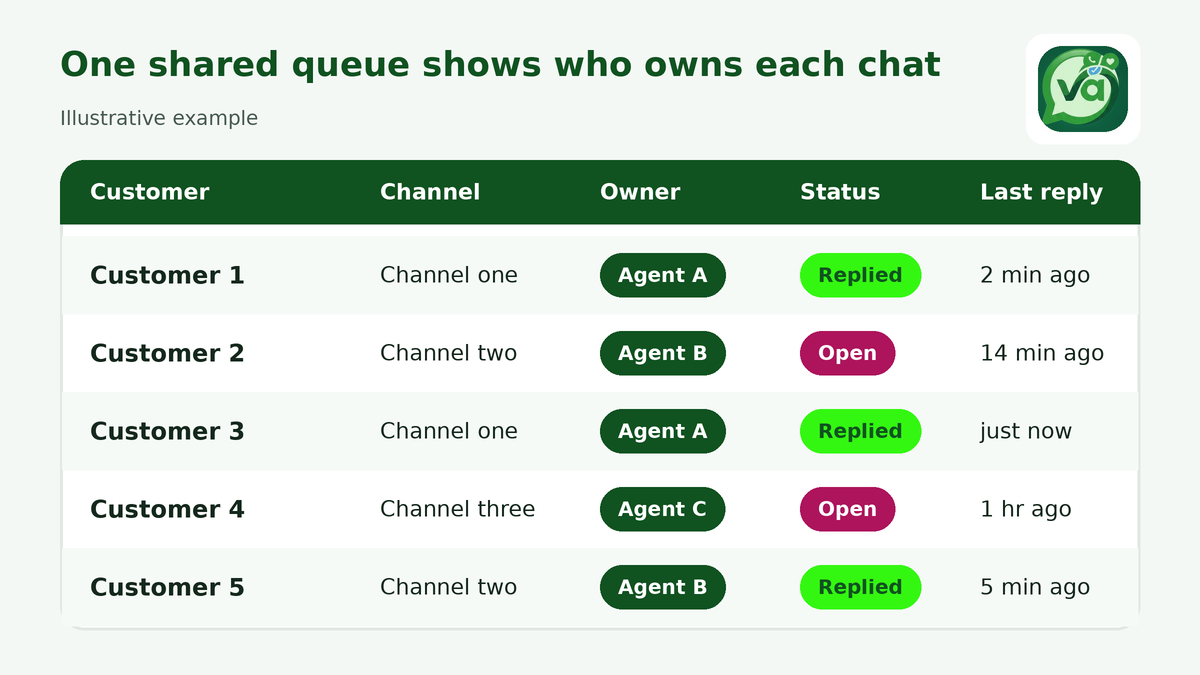
A shared queue is the fix, and it's a simpler idea than it sounds. Instead of each channel living in its own app, every incoming conversation — WhatsApp, Instagram, Messenger, email, web chat — flows into one list that your whole team sees. That's the core of unified messaging: one view, one truth about what's waiting.
The change that matters most isn't the consolidation itself. It's what consolidation makes visible. A proper shared queue shows you three things at a glance:
A visible owner. Every conversation is either unassigned or clearly tied to one person. No more guessing who's got it. If a message is sitting unassigned, that's a flag, not a mystery.
A status. Open, pending, resolved — you can tell at a glance which conversations still need a human and which are done. The backlog stops being a scary unknown and becomes a to-do list you can actually work through.
A last-reply timestamp. You can see exactly how long a customer has been waiting and, on WhatsApp, roughly where you stand against the reply window. That turns an invisible countdown into a number you can act on.
Those three signals do the thing separate apps can never do: they make time and ownership legible. You stop relying on whoever happened to be logged in. Instead, the first person who starts their day sees the whole picture — what came in overnight, who it's for, and what's urgent.
This is the real payoff of treating multi-channel communication as one system rather than a pile of apps. The customer's channel stops mattering internally. A WhatsApp message and an Instagram DM sit side by side in the same queue, sorted by urgency rather than by which app they happened to arrive in. If you're not sure where to start, connecting your channels into one inbox is the first practical step.
A Simple Handover Routine for Always-On Teams
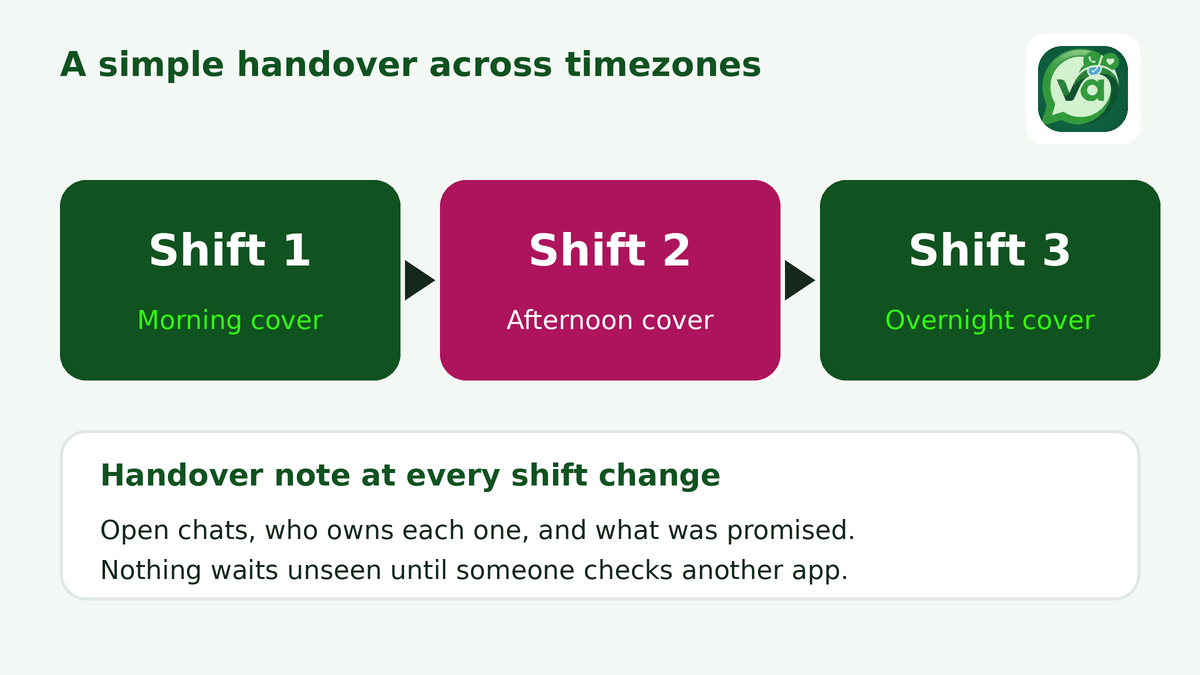
Tools get you a shared view. A routine is what makes the view pay off, especially when your team spans timezones. Even a two-person operation benefits from treating handover as a deliberate act instead of a hope.
Here's a routine that works for always-on teams without requiring 24-hour staffing:
Define coverage blocks, not around-the-clock staffing. Split the day into shifts that roughly match when your customers are most active. You don't need someone awake at all hours — you need someone responsible for each block, and clarity about who's off.
Hand over the queue, not just the shift. When one person logs off, they clear or reassign anything still open. The next person inherits a known state, not a surprise. A quick note on anything half-finished saves ten minutes of re-reading later.
Set an explicit rule for the WhatsApp window. Flag any WhatsApp conversation approaching its reply deadline so the next person answers those first. Sorting by last-reply time usually surfaces them automatically, but make it a named priority anyway.
Use an away message that sets a real expectation. If genuinely nobody is online for a few hours, an honest auto-reply — "We're offline until 8 AM UTC and will reply first thing" — buys patience. Vague silence loses customers. A clear, specific promise keeps them.
Review the overnight backlog as your first task. Whoever opens the day starts with everything that came in while the team slept, sorted by how long each person has waited. Oldest and most time-sensitive first.
None of this requires more people. It requires a shared place to look and an agreement about who looks when. The teams that handle after-hours well aren't bigger — they've just removed the guesswork.
The thing worth remembering
Customers write on their schedule, not yours. You can't control when a message arrives, but you can control whether it lands somewhere a person will see it before the moment passes. Separate apps bury overnight messages until it's too late to answer them well. One shared queue brings them back into view, with an owner, a status, and a timestamp that tells you how urgent each one really is.
So before you add another channel or hire another body, look at what you already have. How are you handling multi-channel communication after hours right now — and would you even know if a message slipped through last night?