
October 24, 2026 · CHARITY
Multi-Channel Communication Gaps That Lose Customers
A customer message at 2 a.m. is still a customer. This guide shows where multi-channel communication gaps open across timezones and how one shared inbox closes them.
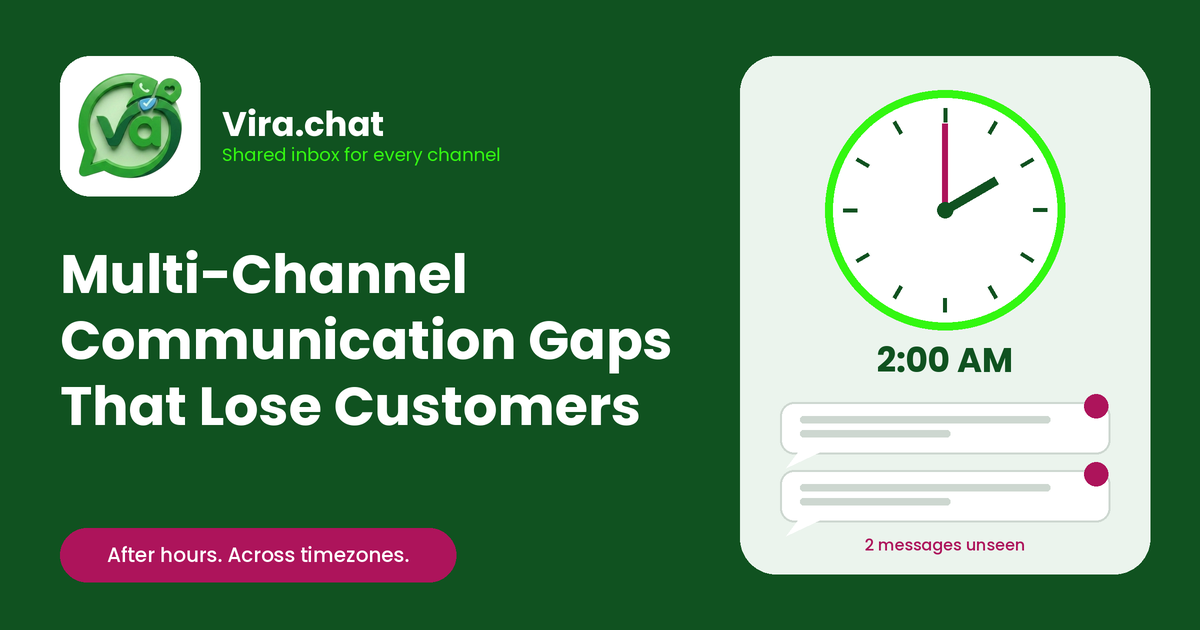
A customer sends a question on Instagram at 9 p.m. their time. You see it at 8 a.m. yours. By then they have already messaged you on WhatsApp, emailed support, and started a chat on your website. Four messages, one frustrated person, and nobody on your team realized it was all the same customer. That is the quiet failure point in multi-channel communication, and it costs more deals than most teams ever notice.
Here is the uncomfortable part. Your tools are probably working exactly as designed. The Instagram app shows Instagram. The email client shows email. Your live chat lives in a separate dashboard. Each one does its job in isolation, which is precisely the problem. Customers do not see channels. They see one conversation with one company, and they expect it to make sense no matter where they left off.
The Gap Hides In Plain Sight
Most support leads assume their coverage is fine because every channel has someone assigned to it. On paper, nothing is dropped. In practice, the gaps open in the seams between tools.
Think about what a single customer journey actually looks like now. Someone finds you through an ad, DMs you on social, gets no reply because it is late, then switches to email the next morning. If the person reading email has no idea about the DM, they answer a question the customer has already half-answered elsewhere. The customer has to repeat themselves. They feel like a ticket, not a person.
That repetition is where trust leaks. Research from Zendesk has shown that customers increasingly expect businesses to carry context across channels, and they punish the ones that cannot. Not with an angry message, usually. With silence, and a purchase somewhere else.
Where Multi-Channel Communication Breaks After Hours
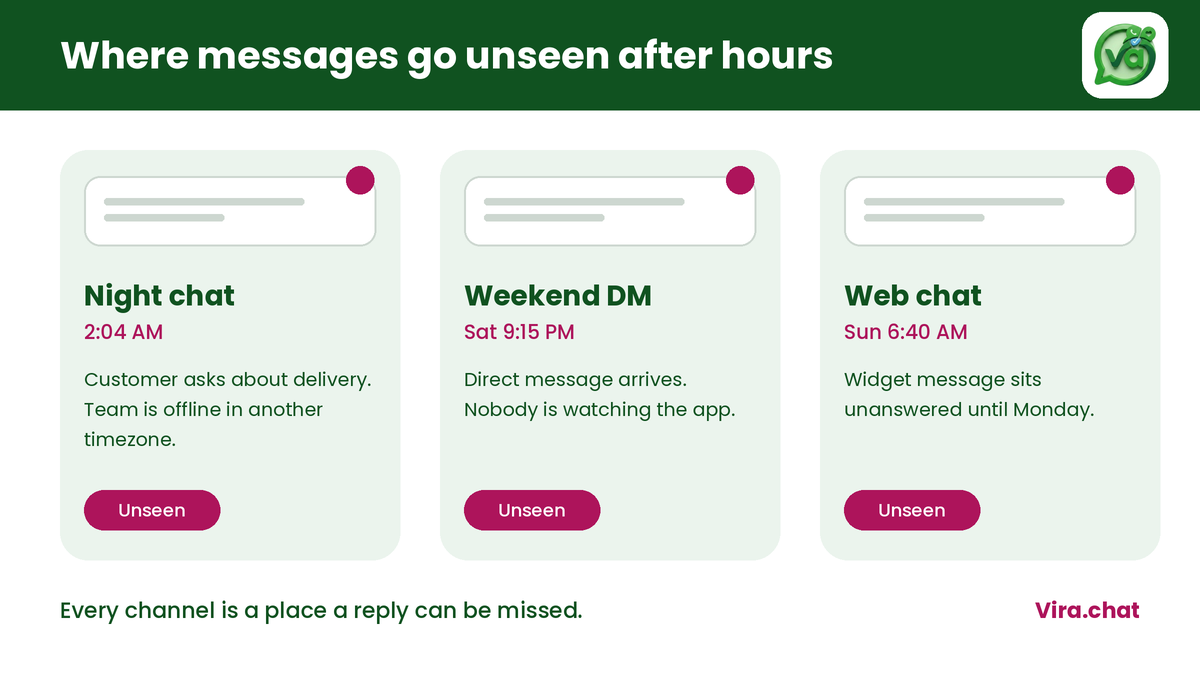
Daytime gaps are survivable. You have people online, and a missed message gets caught within the hour. The real damage in multi-channel communication happens when nobody is watching.
Nights, weekends, and the dead zones between shifts are when messages pile up unseen in separate apps. A question that lands at 2 a.m. on WhatsApp does not wait politely in a shared queue. It sits inside WhatsApp, invisible to the person who handles email, invisible to the website chat owner, invisible until someone happens to open that specific app.
By the time your team logs in, the clock has been running for hours. For a buyer comparing two vendors, that delay is the whole decision. We have written before about why the 24-hour response rule is non-negotiable in the first 24 hours of a customer conversation, and after-hours messages are where that rule quietly dies.
A few things reliably slip through the cracks overnight:
First-time questions from high-intent buyers who were ready to pay
Follow-ups from customers who already messaged a different channel earlier
Complaints that escalate because they feel ignored, not because the issue was big
None of these are hard to answer. They are hard to see, and you cannot answer what you cannot see.
Timezone Handoffs Are Where It Gets Expensive
If you serve customers across regions, you already live with this. Your morning is someone else's midnight. Their business hours are your sleep.
Handling replies after hours across timezones is not a staffing problem you can brute-force forever. You could hire overnight coverage, but then each shift inherits a pile of messages scattered across platforms with no record of what the previous shift saw. The handoff itself becomes a second gap. Multi-channel communication that works within one timezone falls apart the moment a conversation crosses into another, because the context does not travel with it.
Picture a customer in one region who starts a thread on Friday afternoon. Your team in another region picks it up Monday. Three days of channel-hopping on the customer's side, zero continuity on yours. They have explained their problem twice and gotten two partial answers from two people who never compared notes. That customer is not coming back for a third try.
The fix is not more people. It is making sure every message, regardless of channel or hour, lands in a place where the next available person can see the full history and take ownership.
One Inbox, One Owner, One Thread
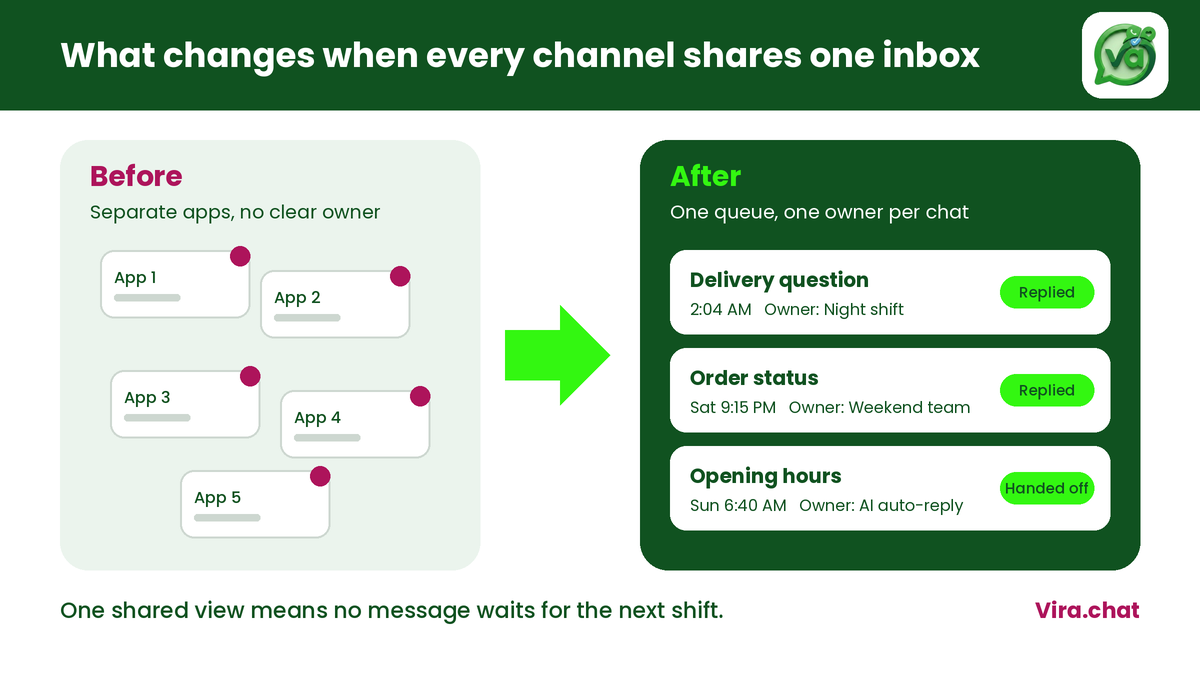
The pattern that actually closes these gaps is boring and effective: pull every channel into a single shared view. When Instagram, WhatsApp, email, and website chat all feed one unified inbox, the four-messages-one-customer problem disappears. The thread is the thread. Anyone who opens it sees the whole story.
This changes the math on after-hours coverage too. Instead of asking someone to monitor five apps overnight, you give them one. A message that arrives at 2 a.m. is visible in the same spot as everything else, with a clear owner so it does not float in a void until three people assume someone else has it.
Tools like Vira.chat are built around this idea. Vira pulls customer messaging from across your channels into one stream, so the person on shift is not jumping between tabs trying to piece together who said what and when. The goal is not another dashboard. It is removing the seams where messages get lost.
What ownership adds on top of visibility is accountability. A shared inbox without assignment just moves the chaos into one window. The version that works attaches a name to every open thread, so nothing sits unclaimed. Visible plus owned is what turns a pile of overnight messages into a clean morning queue instead of a crisis.
What You Actually Gain
Closing these gaps is not about looking organized. It changes outcomes you can measure.
Response times drop because nobody wastes the first ten minutes reconstructing context. Customers stop repeating themselves, which means fewer frustrated escalations. High-intent buyers who message at odd hours get caught instead of forgotten. And your team, honestly, stops dreading the start of a shift because the backlog is one readable list instead of five separate archaeology digs.
There is a retention angle too that is easy to miss. Customers who feel remembered across channels are the ones who come back and tell other people. Every clean handoff is a small deposit in that account. Every "sorry, can you explain that again" is a withdrawal.
Good multi-channel communication is not a feature you bolt on. It is the difference between a customer who feels handled and a customer who feels processed. One of those renews.
So, How Are You Handling This Right Now?
Be honest about your own setup for a second. When a message comes in on social at midnight, where does it go? Who sees it first? Does the person who answers email in the morning know it exists?
If you had to pause on any of those, that is your gap. It doesn't mean your team is bad at their jobs. It means your channels are talking to customers but not to each other.
Map one real customer journey from last week, start to finish, across every channel they touched. Find the point where the thread went dark. That one spot is where you are losing people, quietly, and it is the first thing worth fixing.