
Is Your Instagram Facebook WhatsApp Inbox in One Place?
It's 9:40 in the morning and Grace, who runs a small home décor shop in Nairobi, has already opened Instagram Facebook WhatsApp inbox in one place before her first coffee. Instagram, because someone commented "price?" on a cushion post at midnight. WhatsApp Business inbox, because a repeat customer wants to know if the rug came back in stock. Facebook Messenger, because an old lead from a promo two weeks ago finally replied "still available?"
Three apps. Three tabs of attention. And it's not even 10am.
If that rhythm sounds familiar, you're not disorganized and you're not behind. You're just running a business that outgrew the setup it started with, and almost nobody notices the exact moment that happens.
How three inboxes quietly become a problem
When you have ten messages a week, checking three apps is nothing. You glance, you reply, you move on. The whole thing feels manageable because it is manageable at that volume.
The trouble starts when the volume climbs and the structure doesn't. Suddenly you're not glancing anymore, you're hunting. Which app had that conversation about the wedding order? Did I reply to the Instagram DM or was that the WhatsApp one? Was that the same customer, or two different people asking the same thing?
Nobody sat down and decided to run their customer conversations across three disconnected channels with no shared view. It just accumulated. You got on Instagram because that's where your product looks good. WhatsApp because that's how Kenyans actually talk to businesses. Facebook because it was already there. Each one made sense on its own. Together, they became a coordination problem you never signed up for.
The messages you never even see
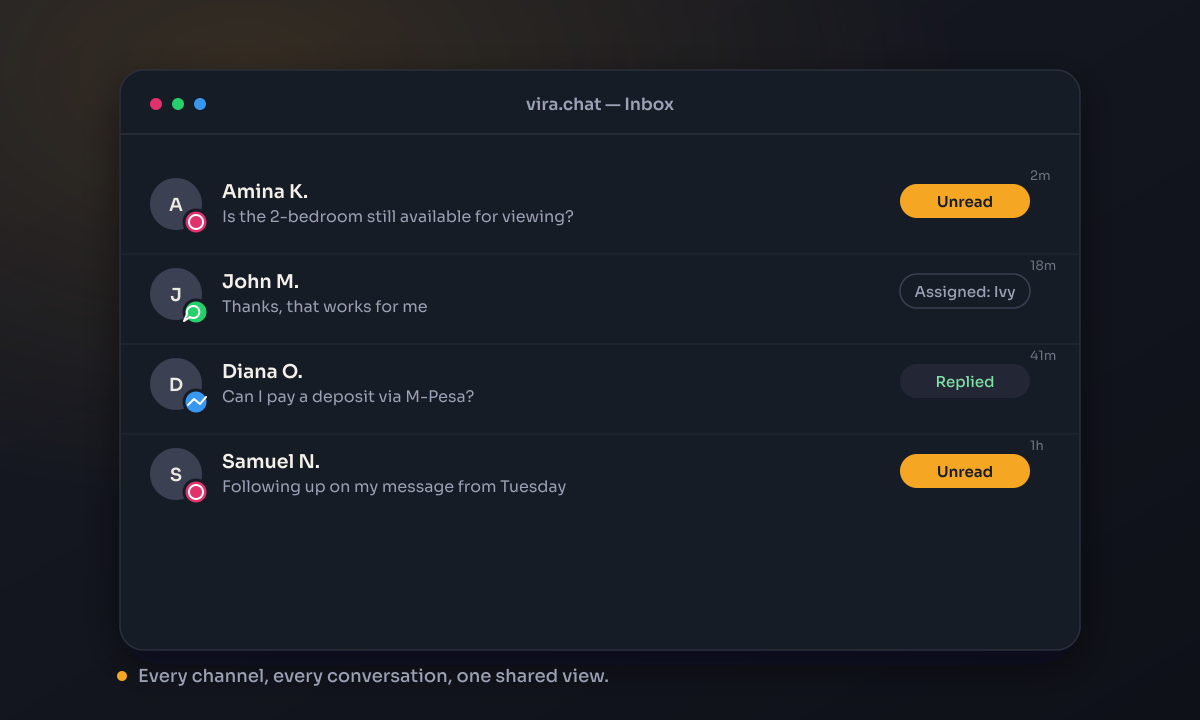
Here's the part that stings: the cost of separate inboxes isn't the messages you answer late. It's the ones you never answer at all.
When a person is watching one app, the other two are effectively invisible. A lead can sit in your Facebook Messenger for six hours while you're heads-down replying to Instagram, and you'd have no idea anything was waiting. There's no single place tapping you on the shoulder saying "hey, someone over here is ready to buy."
Think about what a delayed reply actually means. Someone messaged you because they had intent right then, they were on your page, interested, wallet halfway out. An hour later that intent cools. Two hours later they've messaged a competitor who happened to reply faster. You didn't lose that sale to a better product or a lower price. You lost it because their message landed in the one app you weren't looking at.
Multiply that by a handful of missed conversations a week and the number gets uncomfortable fast.
When "who replied to this?" becomes a daily question
The problem gets worse the moment more than one person handles messages, and it gets worse in a way that's almost invisible until a customer points it out. Two staff members, one is on WhatsApp Business inbox, one is on Instagram. A customer, being a normal human, messages your business on both because they weren't sure which one you'd see. Now two people are replying to the same person, sometimes with slightly different answers, sometimes contradicting each other on price or availability. The customer's confused. Your team looks disorganized. And nobody did anything wrong, they just had no way of knowing the other conversation existed.
The flip side happens just as often. Both staff assume the other one handled the Facebook message. Neither did. The customer waits, hears nothing, and quietly leaves.
Without shared visibility you're stuck with two bad outcomes: customers get double-texted, or they get ignored. There's no reliable middle. And you can't manage what you can't see, if you have no view of who touched which conversation on which channel, you're essentially trusting three separate apps to somehow coordinate themselves. They won't.
The tax nobody puts on the invoice
There's also a cost that never shows up in your numbers but absolutely shows up in your team by 4pm: the mental drain of switching. Every time you jump from Instagram to WhatsApp to Messenger, your brain has to reload the context. Different layout, different conversation, different customer, different tone. It takes a few seconds each time to remember where you were. Do that two hundred times a day and you've spent a real chunk of the day just reorienting, not helping customers, not closing sales, just paying the toll to move between apps.
That constant switching is why people who "just answer messages all day" feel wiped out even on a slow day. It's not the messages. It's the friction between them. Your staff aren't tired because they worked hard. They're tired because they ran three parallel jobs in the same head.
Why this never fixes itself with effort
The instinct, when this starts breaking, is to try harder. Check the apps more often. Assign someone to "keep an eye" on Instagram. Set reminders. Promise yourself you'll do a full sweep of all three every hour. It works for about a week.
The reason it doesn't stick is that you're using discipline to patch a structural gap. As long as the conversations live in three separate places, someone always has to hold the whole picture in their head, and human memory is a terrible place to store your sales pipeline. The system is asking your team to be the integration layer between three platforms. No amount of hustle makes a person reliable at that, day after day, at growing volume. More effort doesn't scale. Better structure does.
A cleaner way to think about it: A Unified inbox
So here's the shift worth sitting with: the goal isn't to check all three channels faster. It's to stop treating them as three separate things at all.
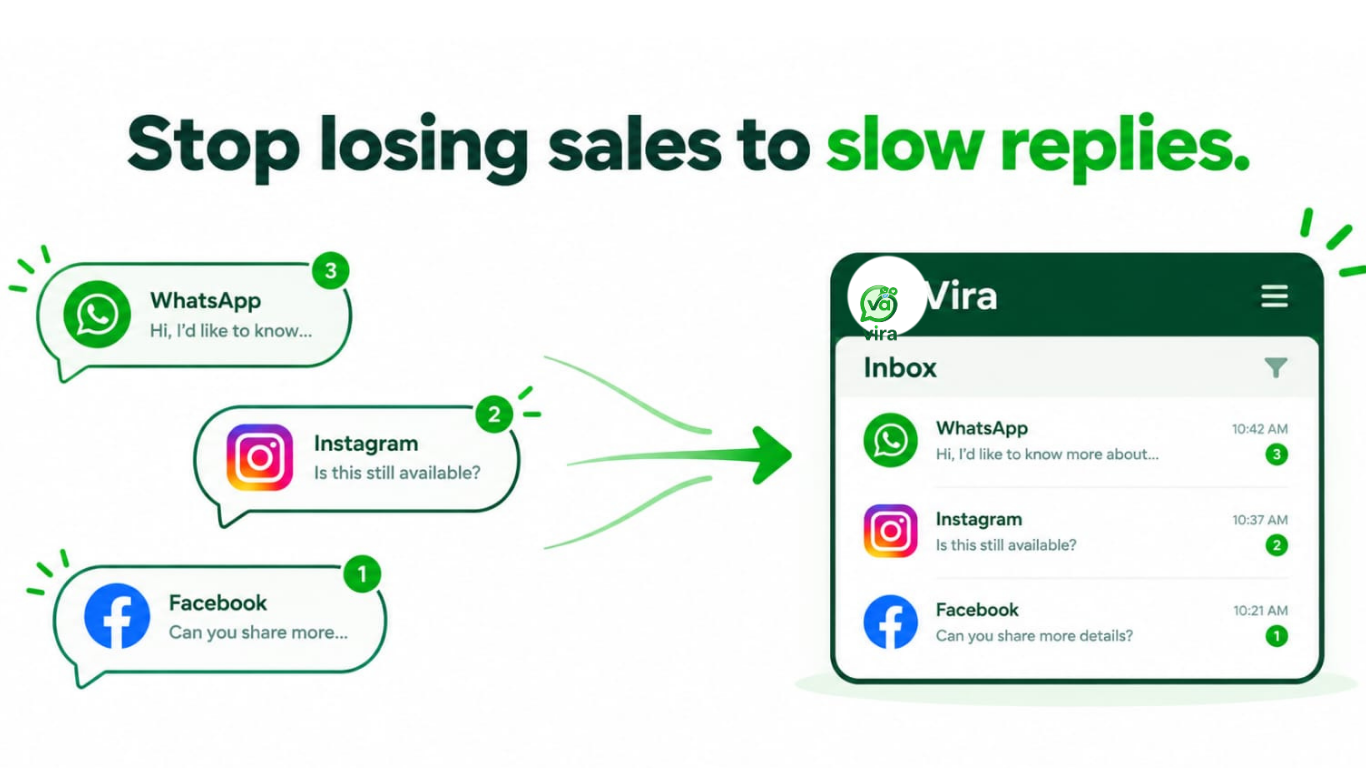
What if every conversation, Instagram DM, WhatsApp chat, Facebook Messenger thread landed in a single stream? One list, sorted by who messaged most recently, regardless of which app they came through. You'd see all conversations in one place, with the customer's name and history right there, no matter which door they walked in.
That's the whole idea behind a unified inbox. Instead of you jumping between platforms, the platforms come to you. Your team works from one screen. You can see at a glance who already replied, so nobody double-texts and nobody assumes someone else handled it. Instagram Facebook WhatsApp inbox in one place, treated as two customers talking to the same business.
This is what people mean by omnichannel communication, though the word is clunkier than the reality. It really just means the customer picks whatever channel is convenient for them, and on your side it all flows into one organized place. They get to be casual about it. You get to be organized about it. Everyone wins except the missed message that used to slip through the gap.
For businesses here specifically, this isn't some far-off enterprise idea. Unified inbox software in Kenya is very much a thing that exists and works with the channels people actually use daily, the same WhatsApp, Instagram, and Facebook your customers already live on.
Is your Instagram Facebook WhatsApp inbox in one place?
You don't need to make a decision today, and you definitely don't need to be sold on a tool right this second. But it's worth doing one honest bit of arithmetic first.
Sit down and count how many separate places a customer can currently reach your business. Then ask who's watching each one, and how you'd know if a message went unanswered on the channel nobody's looking at right now. If the answer to that last part is "we'd probably just miss it", you've found the leak.
That's really the point of naming all this. Running Instagram, WhatsApp, and Messenger as three islands isn't a personal failing,having your Instagram Facebook WhatsApp inbox in one place is the goal. Seeing it clearly is the first step. What you do about it can come next.
For now, notice the app-switching. Notice the "did I already reply to this?" moments. Notice the leads that go cold between channels. Once you start seeing the pattern, it's genuinely hard to unsee, and that's usually the sign it's time for something better than checking three apps and hoping.