
November 27, 2026 · CHARITY
Customer Service Team Size: Hire or Fix the Inbox First?
Customer service costs rise with every hire, but missed chats cost too. This guide helps you decide whether to add agents or fix how replies are handled first.
Published November 27, 2026 · Updated November 27, 2026
A manager pulls you aside on a Friday afternoon and says the same thing you've heard three times this quarter: "We're missing chats. I need another person." It sounds reasonable. The team looks busy, messages are slipping through, and customers are getting annoyed. But before you sign off on another salary, it's worth asking the uncomfortable question that most customer service conversations skip: is the team actually too small, or is the way you handle replies just too scattered to keep up?
Hiring feels like the obvious fix because it's visible. You add a seat, you add a person, the headcount number goes up, and everyone feels like something got solved. The problem is that a new agent dropped into a messy reply process often just gets lost in the same mess, only now you're paying more for it.
Key Takeaways
Count your missed chats before you count headcount. Guesses lead to bad hiring decisions.
Put the real cost of one hire next to the revenue you're losing to slow replies, then compare.
Look for reply gaps first: unclear ownership, messages scattered across apps, and after-hours silence.
Fix the process, then decide on team size with actual numbers in front of you.
How do you know if your customer service team is really too small?
A team is genuinely too small when your chats-per-agent load is high and your first-reply time still can't be rescued no matter how organised people are. If each agent is already handling a reasonable volume and replies still lag, that's a capacity problem. If misses come from chats nobody picked up, that's a process problem, and hiring won't touch it.
Those two problems look identical from the outside. Both show up as "we missed a customer." But they have completely different fixes, and that's exactly why so many businesses hire when they didn't need to. The only way to tell them apart is to actually look at where the misses are coming from, not just that they're happening.
Here's a simple exercise that takes about a week and costs you nothing:
Log every incoming chat for one full week across all your channels: WhatsApp, Instagram, Facebook, TikTok, your website, email, whatever you use.
Mark every chat that went unanswered for more than 24 hours, or that got a first reply so late the customer had already gone quiet.
Tag each missed one with a cause: no owner (the message landed somewhere and nobody claimed it), wrong channel (it came in on an app the right person doesn't check), or after hours (it arrived when nobody was working).
After a week, the pattern usually jumps out. I've watched business owners go into this exercise convinced they were drowning in volume, only to discover that most of their misses were "no owner" chats sitting unseen in a shared Instagram account that four people half-watched and nobody fully owned.
If the bulk of your misses are "no owner" or "wrong channel," you have a coordination problem, and a new hire is a very expensive way to patch a coordination problem. If most of your misses are genuine after-hours messages, you might need different shift coverage or automation, not necessarily more daytime staff. And if your agents are each fielding 60 or 70 live conversations a day and still can't keep up, then yes, you're short-handed, and now you've got the data to prove it.
Why busy does not always mean understaffed
A team can look flat-out and still be badly structured. People spend a shocking amount of time switching between apps, re-reading threads to figure out who said what, and asking each other "did you reply to this one?" in a side chat. That motion feels like work, but a big chunk of it is overhead created by the tools, not by customer demand.
I once sat with a small online shop in Nairobi that had three people glued to their phones all day. They were exhausted and certain they needed a fourth. When we timed their actual work, nearly 40% of their day went to toggling between the WhatsApp Business app, the Instagram app, and a Facebook Page, plus the little coordination dances in between. The customers weren't the problem. The tool sprawl was. They didn't hire. They consolidated, and the "crisis" quietly disappeared.
What does one missed lead cost compared with one more agent?
This is the heart of the whole decision, and it's where I want you to get specific rather than emotional. Let's run real numbers, because "we're losing customers" and "it costs too much to miss chats" are just vibes until you put figures on them.
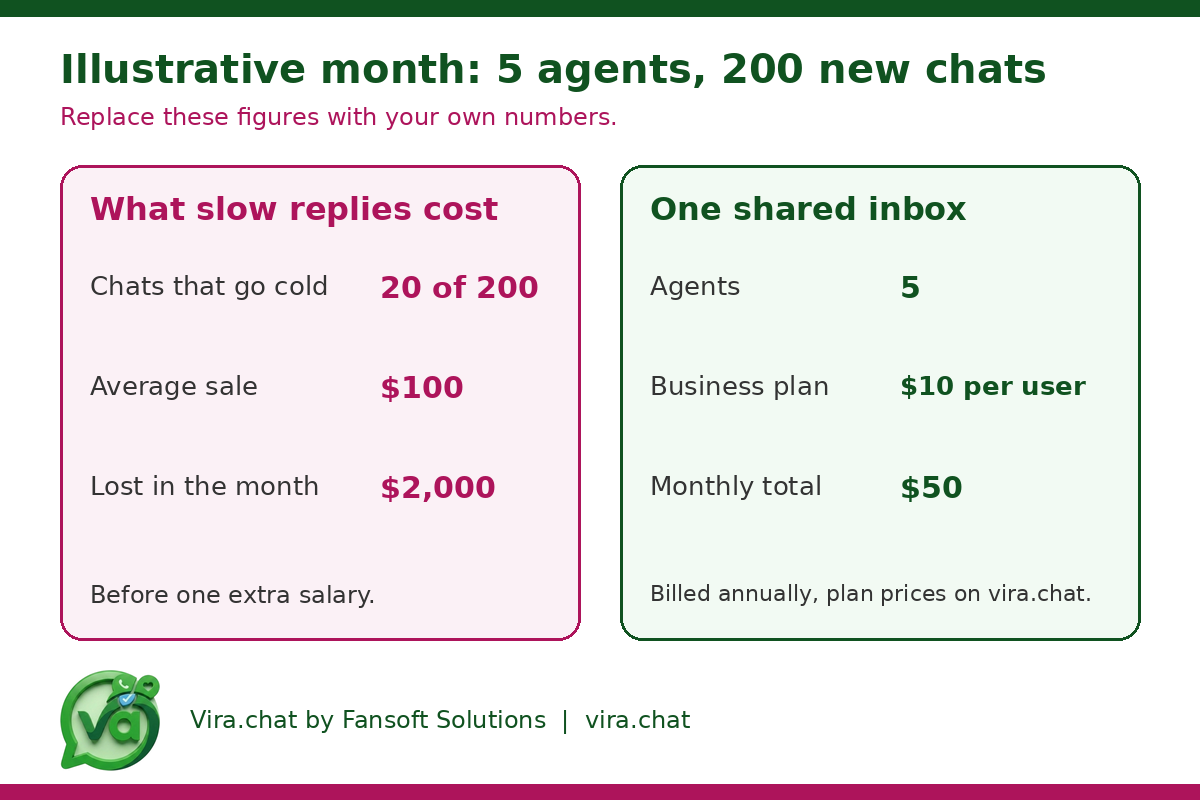
Take an illustrative month. You've got 5 agents handling 200 new chats. Say 20 of those chats go cold, meaning the customer reached out, didn't get a timely reply, and drifted away. If your average sale is worth around Ksh 13,000, those 20 lost conversations represent roughly Ksh 260,000 in revenue that walked out the door. Even if only half of those would have converted, you're still looking at Ksh 130,000 gone in a single month from slow or missed replies.
Now look at the cost side. Adding one more agent doesn't just mean their salary. It means onboarding time, management attention, a workstation, and the ramp-up weeks where they're slower than the rest. In Kenya, a decent customer support agent might cost you somewhere between Ksh 35,000 and Ksh 60,000 a month in salary alone, before you add everything around them. So you're weighing a recurring cost of that size against the question of whether that new person will actually recover the Ksh 130,000 you're bleeding.
Here's the catch that trips people up. If those 20 missed chats were "no owner" misses, a sixth agent doesn't fix them. You'd just have six people all assuming someone else grabbed the message. The leak stays open, and now your payroll is higher. That's the worst of both worlds: more cost, same lost revenue.
The cheaper experiment to run first
Before you compare the cost of a hire to lost leads, there's a third number worth putting on the table: the cost of fixing the process itself. Tightening up how messages are routed and owned is almost always cheaper than a salary, and it's reversible if it doesn't work.
A shared inbox tool that pulls all your channels into one place and assigns ownership to messages typically costs a fraction of one agent's monthly pay. For a team of 5, you might be looking at something in the range of Ksh 6,000 to Ksh 8,000 a month total, not per person. Compare that to Ksh 40,000-plus for a new hire and the decision starts to look obvious: test the cheap fix first, measure the result, and only add headcount if the misses persist once the process is clean.
Think of it like a leaking roof. You don't hire a second family to catch the drips in buckets. You patch the roof. Hiring to solve a reply-process problem is the organizational version of the bucket brigade.
The three reply gaps that fake a staffing shortage
When you tag those missed chats, you'll almost always find the same three culprits behind the "we need more people" feeling. None of them are solved by headcount.
Unclear ownership
This is the big one. A message arrives, it's visible to the whole team, and precisely because everyone can see it, nobody feels responsible for it. Psychologists have a name for this: the bystander effect. The more people who could act, the less likely any single person is to step in. Your shared WhatsApp line is a textbook case. Five agents glancing at it, each assuming one of the others has it handled, and the customer waits two hours for a reply that any of them could have sent in thirty seconds.
The fix isn't a sixth bystander. It's assignment. When a message has a name attached to it, "I thought you had it" stops being a valid excuse, and reply times drop without a single new hire.
Scattered apps
Most small and mid-sized businesses grew their channels one at a time. You started on Facebook, then customers wanted WhatsApp, then Instagram DMs picked up, then someone on TikTok slid into your comments, and now you've got a website chat widget too. Each one lives in its own app with its own login and its own notification sound. Your team is effectively playing whack-a-mole across five screens.
Scattered customer messaging is exhausting and it's where a lot of misses hide. A customer who messages you on Instagram and then follows up on WhatsApp looks like two strangers to a team working across separate apps, when it's really one person getting more frustrated. Bringing those conversations together isn't a luxury. It's the difference between knowing your customer and constantly starting from zero.
After-hours silence
Customers message when it suits them, which is often at 9pm or on a Sunday. If every chat that lands outside working hours sits untouched until morning, you're racking up misses that no daytime hire will ever catch. By the time your team logs on, that late-night shopper has already bought from a competitor who had an auto-reply or a quicker morning response.
This gap usually needs automation and smart expectations rather than bodies. A simple auto-acknowledgement that sets a reply window, a saved answer for the three questions you get most, or routing urgent keywords to someone on call will plug far more after-hours leaks than adding a person who also goes home at 6pm.
Running the decision properly: a short framework
So you've logged a week, tagged your misses, and you've got real numbers. Here's how I'd walk through the decision, in order.
First, calculate your genuine miss rate and where it comes from. If 70% of misses are no-owner or wrong-channel, your problem is process. Fix that before anything else. If 70% of misses are after-hours, your problem is coverage and automation. If your agents are each carrying a punishing live load and misses persist even on a clean process, your problem is capacity, and you've earned the right to hire.
Second, put three costs side by side: the monthly cost of one new hire fully loaded, the monthly revenue you're losing to misses, and the monthly cost of a tool that unifies your channels and assigns ownership. In most teams I've seen under genuine strain, that third number is the smallest by a wide margin, which tells you where to start.
Third, run the cheap fix for 30 days and re-measure. Don't guess at whether the process change worked. Log another week, re-tag your misses, and compare. If your miss rate drops from 20 chats to 4, you just saved yourself a salary and solved the problem. If it barely budges and your agents are still buried, now you hire with confidence and clean data, not a hunch.
This order matters because it's reversible and honest. Hiring first and hoping is expensive and hard to walk back. Testing the process first is cheap and tells you the truth either way.
What good support actually feels like once the process is fixed
When ownership is clear and channels are unified, the whole feel of a customer service operation changes. Agents stop asking each other "did you get this?" because the system already answered that. New messages route to a named person. Nothing sits unclaimed. The frantic app-switching stops, and the same team that felt understaffed last month suddenly has breathing room.
Customers feel it too. Reply times get faster not because people are working harder, but because the friction between a message arriving and a human seeing it is gone. A business that replies in minutes instead of hours wins deals it used to lose, and it does that often without adding a single head to payroll. That's the quiet win most managers overlook when they default to hiring.
There's also a morale angle that's easy to miss. Agents hate the feeling of chaos, of knowing things are slipping and not being able to tell what. A clean inbox with clear ownership isn't just more productive. It's less stressful, and stressed teams quit, which then forces you to hire anyway for the wrong reasons. Fixing the process protects the people you already have.
If you want to go deeper on how response time affects conversion, the research backs up the gut feeling. Studies on lead response have shown that contacting a customer within the first few minutes dramatically increases the odds of connecting compared to waiting even an hour. Harvard Business Review's work on lead response time found companies that responded within an hour were far more likely to qualify a lead than those who waited longer. Speed isn't a nice-to-have. It's the whole game.
Where a unified inbox fits the decision
Everything above points to the same conclusion: most "we're too small" problems are really "we're too scattered" problems, and the fix is cheaper than a hire. That's exactly the gap a shared workspace closes.
Vira.chat is a unified inbox for WhatsApp, Instagram, Facebook, TikTok and website chat, built by Fansoft Solutions. It pulls every channel into one screen, so your team stops hopping between apps and starts working from a single view. Each conversation can be assigned to a specific person, which kills the no-owner misses that fake a staffing shortage. And the whole thing costs a fraction of what a new agent does, so you can run the cheap experiment I described, measure the result, and make the headcount call with real numbers instead of a Friday-afternoon hunch.
If you're staring at a hire request right now, do the one-week audit first. Log your chats, tag your misses, and see whether the problem is really volume or just a scattered process wearing a staffing costume. Then try a unified inbox for a month and watch what happens to your reply times before you ever touch payroll. The best customer service decisions are the ones you make with evidence, and this one's cheap to get right.