
November 2, 2026 · CHARITY
Customer Service Handoffs: Why Customers Repeat Themselves
Customer service handoffs are where customers end up repeating themselves. See why context gets lost between agents and channels, and how one shared conversation keeps every agent informed.
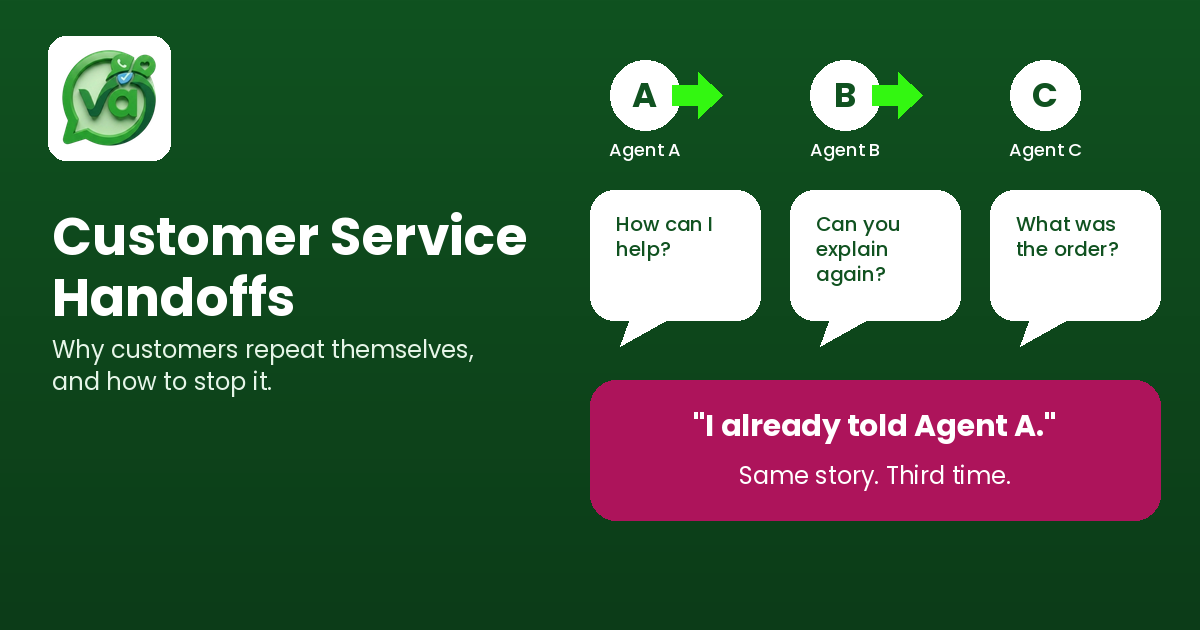
You know the feeling. You spend five minutes explaining your problem to one person, get told "let me pass you to a colleague," and then the whole thing starts over. Same question, same backstory, same sigh. This is the single most common complaint in customer service, and it almost never happens because agents stopped caring. It happens because the context gets dropped somewhere between one person and the next. Good customer service should carry your story forward, not make you tell it again, and the difference usually comes down to how handoffs are handled.
What is a customer service handoff?
A customer service handoff is when a conversation moves from one agent, channel, or shift to another. The customer stays the same, but the person helping them changes. Done well, it's seamless. Done badly, it forces the customer to re-explain everything. The handoff itself isn't the problem, it's whether the context travels along with it.
Why customers repeat themselves
Picture this. A customer messages your team on social media about a broken order. The first agent can't resolve it, so they say "I'll loop in our shipping team." The shipping team asks the customer to email the details. Then someone calls to "confirm a few things." By the third contact, the customer has told the same story three times to three different people.
Here's what's actually going on under the hood.
The channels are separate. Social messages live in one app, email in another, calls in a third. None of them talk to each other, so when the conversation jumps channels, the history doesn't come with it.
The tools are separate. One agent uses the help desk, another checks a spreadsheet, a third works from their personal inbox. There's no single place where the full thread lives.
Nobody owns the conversation. When everyone is responsible, no one is. The customer bounces around because no single agent has said "this one is mine, I'll see it through."
And there are no notes. Even when an agent wants to hand off cleanly, there's often nowhere to write down what was already discussed. So the next person starts cold.
None of this is about effort. Your team is trying. The system just isn't built to pass context along.
What repeating costs
\This gets expensive fast, and not just in patience. Every time a customer re-explains their issue, resolution time stretches. A ticket that should close in one touch now takes three or four, each with its own wait.
Then there's the emotional toll. Having to repeat yourself feels like being ignored, and that frustration colors how people see your whole brand. Research consistently shows that effort is one of the strongest predictors of loyalty, which is why reducing customer effort matters more than piling on extra perks. A clunky handoff is pure effort with nothing to show for it.
And your agents lose time too. Reading the same situation from scratch, re-asking questions a colleague already asked, hunting for context that should have been right there. Multiply that across hundreds of conversations a week and you're paying real money for the same work done twice.
How Vira.chat fixes customer service handoffs
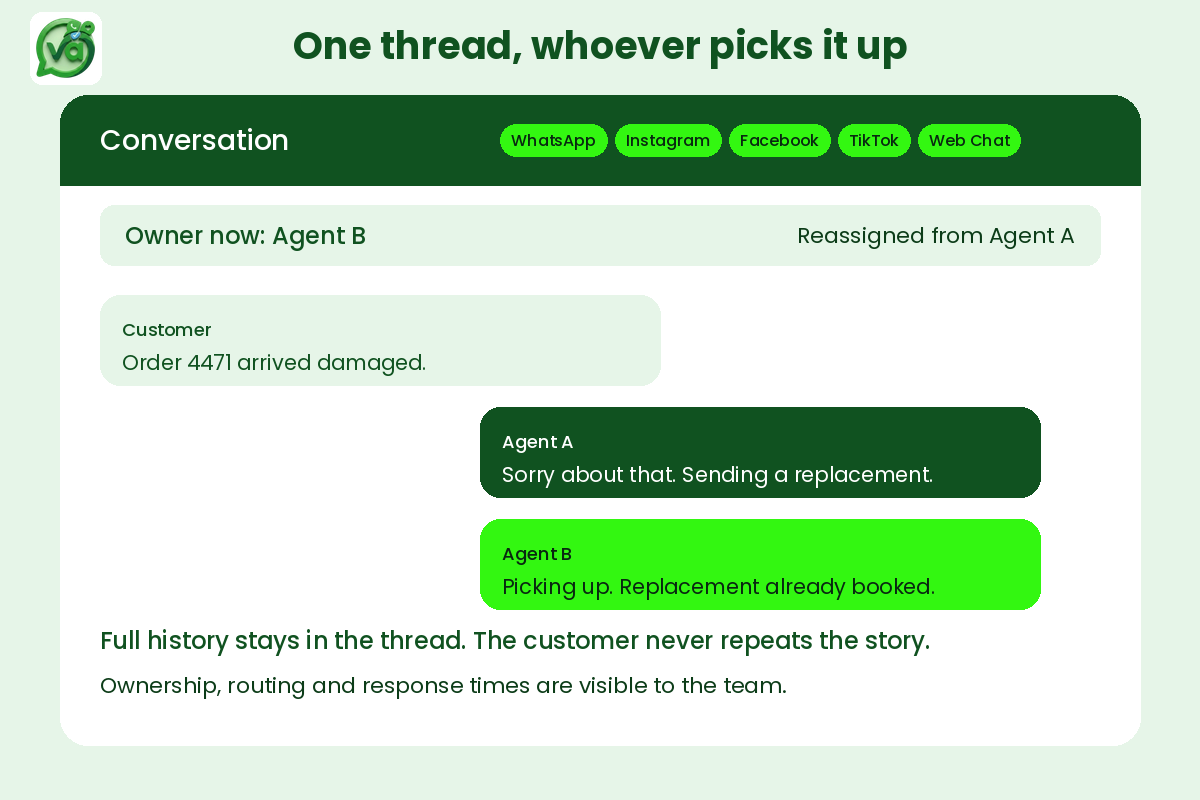
The answer isn't "try harder." It's giving your team a shared view so context moves with the customer automatically. That's the whole idea behind how Vira.chat handles customer service. Here's how the pieces fit together.
One unified inbox
Instead of jumping between apps, every message from every channel lands in one place. Social, email, chat, all of it shows up as a single thread per customer. When an agent opens a conversation, they see the complete history, not a fragment. The unified inbox means a handoff between channels doesn't mean a handoff between tools, because there's only one tool.
Clear conversation ownership
Every conversation gets an owner. One name, visible to the whole team, responsible for seeing it through. If it needs to move to someone with more expertise, ownership transfers cleanly and the new owner inherits the full thread. No more "I thought you had it." The customer always has someone accountable for their issue.
Smart Routing
The right conversation reaches the right person the first time. Instead of a message bouncing from a general queue to one agent to another, Smart Routing sends it where it belongs based on topic, language, or team. Fewer hops means fewer chances to lose the thread, and the customer skips the "let me transfer you" dance entirely.
Built-in CRM history
The real magic is memory. With customer history built in, any agent can see past orders, previous conversations, and earlier notes the moment they open a chat. So even when a new agent steps in, they already know who this person is and what's been happening. The customer never has to catch anyone up, because the record does it for them.
What a good handoff looks like
A clean handoff doesn't require much. It just requires passing the right things along. When an agent moves a conversation, they should carry forward:
The customer's actual problem, in plain words, not a ticket code
What's already been tried or promised
Any deadlines or sensitivities, like a frustrated tone or a shipping cutoff
The next concrete step, so the new owner knows exactly where to pick up
If that information travels with the conversation, the customer notices the smoothness without ever knowing a handoff happened. That's the goal: invisible transitions.
Where to start
You don't need to overhaul everything at once. Start small.
Pick your busiest channel and bring it into a shared inbox where the whole team can see it.
Assign an owner to every open conversation so accountability is obvious.
Write a two-line handoff habit into your workflow: problem, status, next step. Make it the norm before anyone passes a chat along.
Do those three things and the "explain it again" moments start disappearing on their own.
FAQ
What is a customer service handoff?
It's when a customer conversation moves from one agent, channel, or shift to another. The person helping changes while the customer stays the same. A good handoff keeps the full context intact so the customer never has to repeat themselves.
Why do customers have to repeat themselves so often?
Because the history gets left behind when a conversation changes hands. Separate tools, separate channels, and no shared record mean the next agent starts with nothing. Fixing that is a system issue, not a staffing one.
How does a unified inbox help?
It puts every message in one thread with a clear owner and full history attached. So anyone who steps in can see what's already happened and continue instead of starting over.
Give your team one shared conversation
If your customers keep repeating themselves, the fix isn't more scripts or more apologies. It's one connected thread that every agent can see. Try Vira.chat free for 14 days and watch how much smoother your customer service gets when context finally travels with the customer instead of getting lost in the handoff.