
October 31, 2026 · CHARITY
Customer Service Handoffs: Stop Making Customers Repeat
Customer service breaks down at the handoff, when a chat moves between agents or channels and the customer starts over. Here is what it costs and how to fix it.
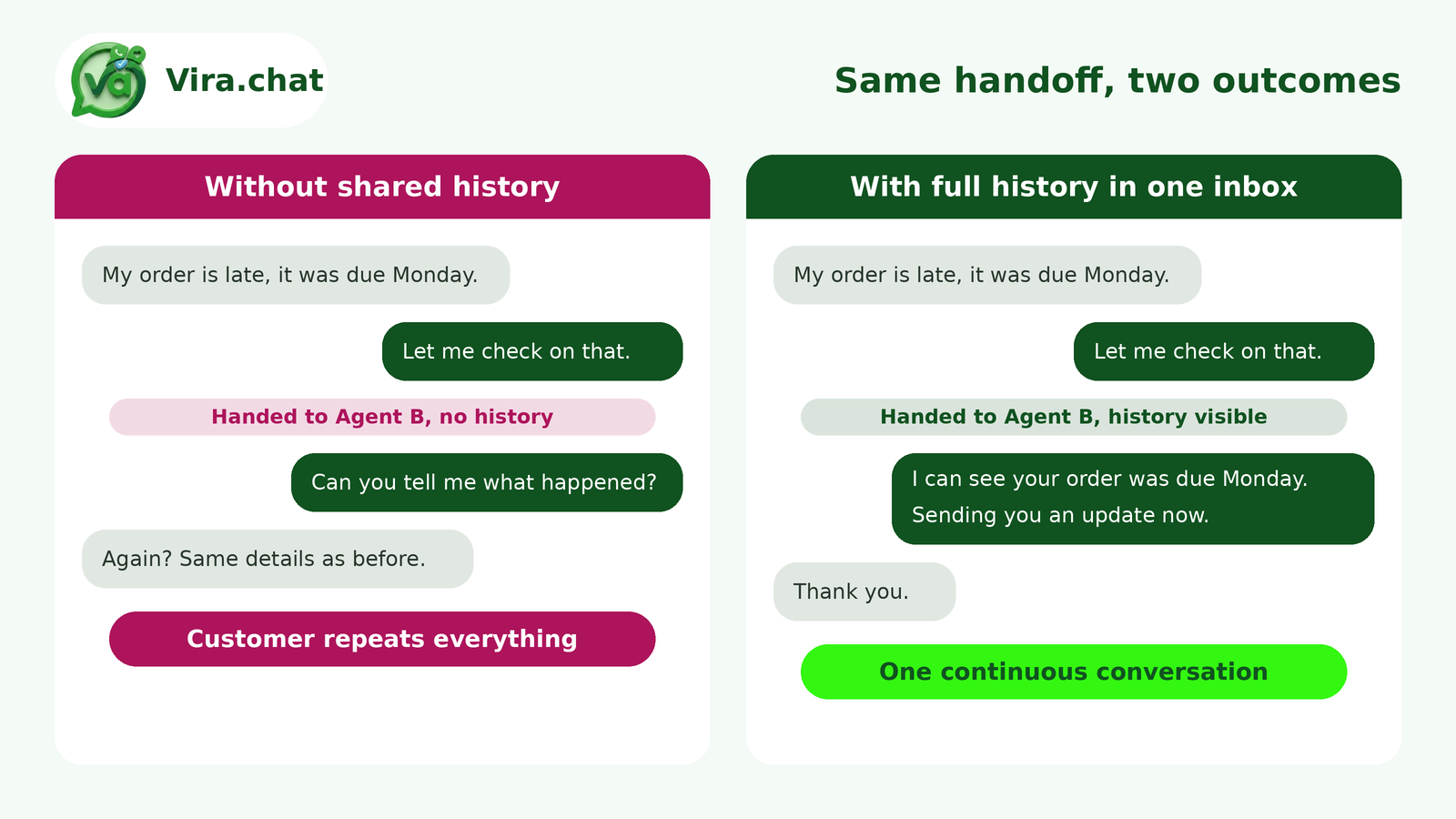
A customer messages your brand on Instagram about a delayed order. No reply by the end of the shift, so the next morning she follows up on WhatsApp. A different agent opens the thread, sees nothing, and types the line that makes people grind their teeth: "Can you tell me what happened?" So she explains the whole thing again. You can almost feel the sigh in her next message. That single moment, where customer service forgets what the customer already said, is where a lot of goodwill quietly dies.
Handoffs are supposed to help. One agent passes a tricky issue to someone better placed to solve it. A night shift ends and a morning shift picks up. A WhatsApp chat gets escalated to a manager. All normal. The problem is not the handoff itself. The problem is what gets dropped on the way across.
Why customer service handoffs lose customers
When context disappears at a handoff, the cost shows up in three places at once.
First, the customer repeats themselves. Order number, the problem, what they already tried, what the last agent promised. Every repeat feels like starting from zero, and it tells the customer that nobody is really paying attention.
Second, handling time climbs. Your agent spends the first two minutes of every conversation reconstructing a story that already exists somewhere. Multiply that across hundreds of chats a week and you have a support team doing archaeology instead of solving problems.
Third, people simply give up. A frustrated customer who has explained the same issue twice is far more likely to abandon the conversation and go quiet, or worse, go public. Research from PwC on customer experience found that a meaningful share of consumers will walk away from a brand they otherwise love after just a few bad experiences.The takeaway is blunt: friction does not get forgiven for long.
Here is the part that stings. None of these customers are angry about the delayed order anymore. They are angry about being treated like a stranger by a company they have already spoken to. The handoff turned a solvable issue into a trust issue.
What is a customer service handoff?
A customer service handoff is the moment a conversation moves from one agent, team or channel to another. It becomes a problem when the new agent cannot see what was already said, so the customer repeats details. A shared inbox with full conversation history and a clear owner keeps context intact through every handoff.
That definition is simple, but the second sentence is where most teams quietly fail. The handoff is not the enemy. The missing history is.
Where context gets lost: three common handoffs
Most lost-context moments fall into a handful of predictable patterns. Knowing them helps you spot where your own process leaks.
Agent to agent. A shift change, a break, or an escalation to someone senior. The second agent inherits the customer but not the backstory, unless your tools carry the notes and the full thread across with them.
Channel to channel. The customer starts on Instagram, then reaches out on WhatsApp because it was closer to hand. To your system these can look like two different people having two unrelated chats. To the customer, it is one problem they have now explained twice.
After hours. A message lands at midnight. The morning team opens it cold, with no visibility into what was said the night before or what, if anything, was promised. The customer wakes up expecting progress and gets a fresh round of questions instead.
Notice what links all three. In every case the information existed. It was typed, sent, and sitting somewhere. It just was not in front of the person who needed it at the moment of the handoff. That is a tooling and process gap, not a staff attitude problem, and it is fixable.
Why "just check the notes" is not a plan
The usual advice is to tell agents to read the thread before replying. Fine in theory. In practice your team is juggling dozens of open conversations across different apps, each with its own login, its own notification badge, its own tab. Expecting a human to manually stitch an Instagram DM to a WhatsApp chat to an email, all under time pressure, is setting them up to miss things. The fix has to be built into the system, not bolted onto good intentions.
How Vira keeps customer service context intact
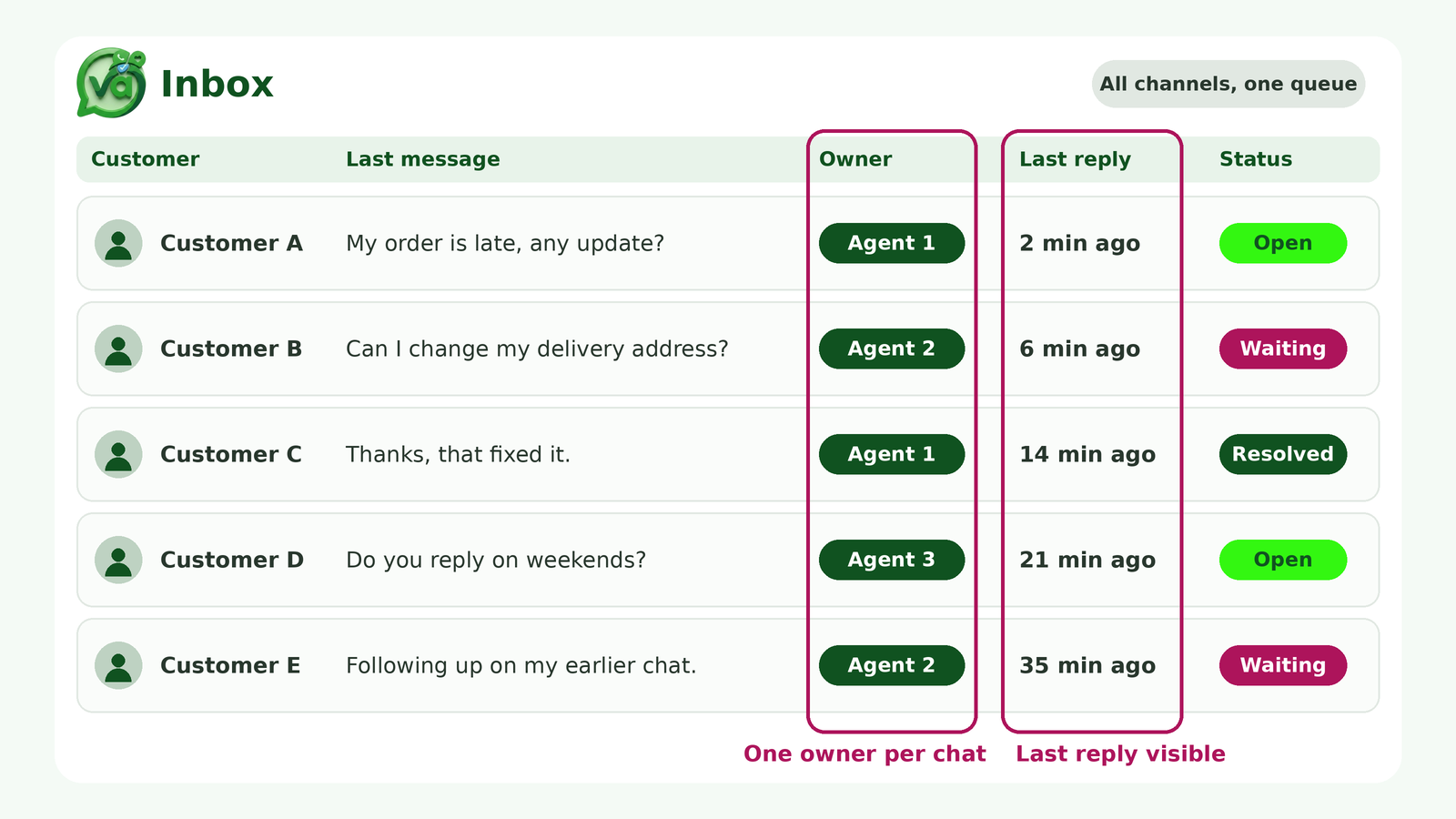
This is the exact problem a unified inbox is built to solve. Instead of a separate screen for every platform, Vira pulls your messages into one place so a conversation stays a conversation no matter where it started.
A few things change the moment context travels with the customer:
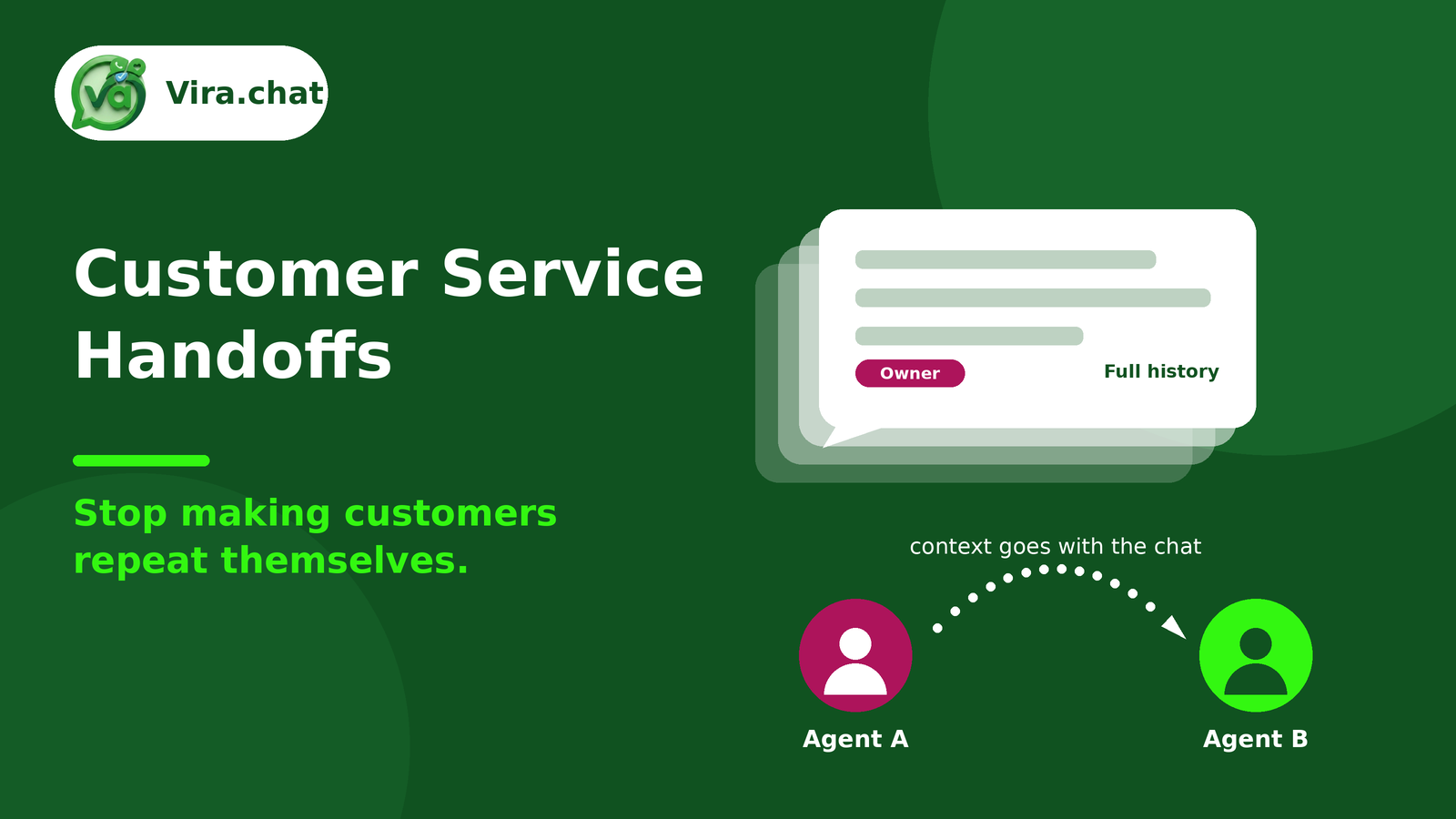
One continuous thread. When the customer who messaged on Instagram follows up on WhatsApp, the agent sees the earlier exchange right there. No re-asking, no guesswork. The handoff happens, but the history stays put.
A clear owner. Every conversation has someone responsible for it, so escalations and shift changes do not turn into a game of "I thought you had that one."
Internal notes that stick to the chat. The night agent can leave a quick note for the morning team, and it is attached to the customer, not lost in a side channel.
The practical result is that omnichannel communication stops being a liability and starts being a strength. Customers get to reach you wherever is convenient for them, and you still treat the whole thing as a single, coherent story. That is the real promise of good customer messaging: the medium changes, the memory does not.
For a growing team, this also lifts a quiet burden off your managers. You stop refereeing "who dropped the ball" conversations because ownership and history are visible to everyone. New hires get up to speed faster because they can see how a resolved issue actually played out, start to finish. And your experienced agents spend their energy on the hard, human parts of the job instead of re-asking for order numbers.
What good handoffs feel like for the customer
Picture the same delayed-order scenario, but done right. The customer messages on Instagram at night. The morning agent on WhatsApp opens the thread, sees the order number, the complaint, and the note the night shift left saying "waiting on the courier update." The agent opens with: "Hi, I can see your order from yesterday is still being chased with the courier. I have an update for you." No repeating. No cold start. The customer feels recognized.
That one difference, being remembered instead of re-interviewed, is what separates support that people tolerate from support that people recommend.
Make the handoff invisible
The goal is not to eliminate handoffs. You will always have shift changes, escalations and customers who move between channels. The goal is to make the handoff invisible to the customer, so they never feel the seam between one agent and the next.
Start by mapping where your own conversations currently fracture. Watch for the "can you tell me again" messages in your logs, because each one is a seam the customer felt. Then put the history where your agents actually work, in one shared view, with a clear owner on every chat.
If repeat questions and lost threads are eating into your team's time, this is the fix worth testing first. Try Vira free and see how a unified inbox keeps every customer service conversation whole, from the first message to the last, no matter who picks it up or where it travels.