
The 10-Minute Response Time Audit Every Omnichannel Business Should Run

Most business owners believe their team responds to customer messages quickly. Ask them, and they'll say "within an hour, usually." Then they actually look at the data and find messages sitting unread from three days ago, scattered across whichever omnichannel messaging channel the customer happened to pick that day.
The gap between what you think your response time is and what it actually is can cost you real sales. A customer who messages you on Instagram at 9pm and gets a reply the next afternoon has probably already bought from a competitor who answered in twenty minutes.
The good news: you don't need software or a consultant to find out where you stand. You need about ten minutes and a willingness to look at some uncomfortable numbers. Here's how to run the audit yourself.
Step 1: Pick Your Sample
You don't need to review months of history. That's how people talk themselves out of doing this at all.
Instead, grab the last 20 to 30 incoming conversations across your channels from the past week or two. That's a big enough sample to spot patterns without drowning you in scrolling. Open up:
WhatsApp Business
Instagram DMs
Facebook Messenger
Your website chat (or the email inbox it forwards to)
Keep a note open, whether that's your phone's notes app or a scrap of paper. You'll jot down a few things per conversation.
Step 2: Log the Response Gap for Each Message

For each conversation, find two timestamps: when the customer first messaged, and when someone from your team first replied. The difference between them is your response gap.
Write it down in rough terms rather than aiming for precision to the second. Use simple buckets like:
Under 5 minutes
Under 1 hour
Same day
Next day
More than 24 hours
Never replied
That last bucket matters most, so be honest about it. If a conversation just ends with the customer's question hanging there, mark it as "never replied." Don't count an emoji reaction or a "we'll get back to you" auto-message as a real response.
Do this channel by channel. It reads faster than it sounds, most conversations take a few seconds to check.
Step 3: Spot the Dead Conversations
Now scan for every conversation in that "never replied" pile. These are the ones that quietly hurt the most, because each one is usually a person who wanted to buy, book, or ask a real question and got silence instead.
Count them. If you sampled 25 conversations and 4 of them never got a reply, your unanswered-message rate is 16%. That means roughly one in six people who reached out got ignored.
Most business owners guess their rate is close to zero. When they actually count, single-digit percentages are good, and plenty of small teams sit north of 20%. If yours is high, the fix is rarely "work harder." It's usually that messages are scattered across separate apps and something always falls through.
Step 4: Calculate Your Average Response Time
Take your replied conversations and estimate a rough average. You don't need a spreadsheet. Just eyeball your buckets.
If most fell into "under 1 hour" with a few "next day" outliers, your practical average is probably a couple of hours. If half landed in "same day" and "next day," you're looking at something closer to 8–12 hours.
Do this per channel, not just overall. This is where the real insight hides. It's common to answer WhatsApp in fifteen minutes because it pings your phone, while Instagram DMs sit for a day because nobody's checking that app during work hours. One channel can quietly drag your entire omnichannel messaging experience down without anyone noticing.
Step 5: Compare Against What Customers Actually Expect
Now the reflection part. Your numbers only mean something against the standard customers hold you to, and that standard has crept up fast.
Here's a rough sense of what people expect by channel:
Live website chat — a reply within minutes. It's called live chat for a reason.
WhatsApp and Messenger — an answer within an hour or two during business hours.
Instagram DMs — treated like texting a friend, so same-day already feels slow to a lot of younger buyers.
Studies on lead response have found that answering within five minutes versus thirty minutes can multiply your odds of actually connecting with someone. Interest is highest the moment they message, and it cools quickly after that.
So put your real averages next to those expectations. Wherever the mismatch is biggest, that's your priority.
What to Do With What You Found
By now you should have three numbers per channel: your typical response time, your slowest channel, and your unanswered-message rate. That's more visibility than most businesses ever get.
The point isn't to feel bad about it. Slow response times are almost never a motivation problem, they're an attention problem. When omnichannel messaging means juggling four separate apps on someone's personal phone, mixed in with spam and unrelated notifications, delays become inevitable.
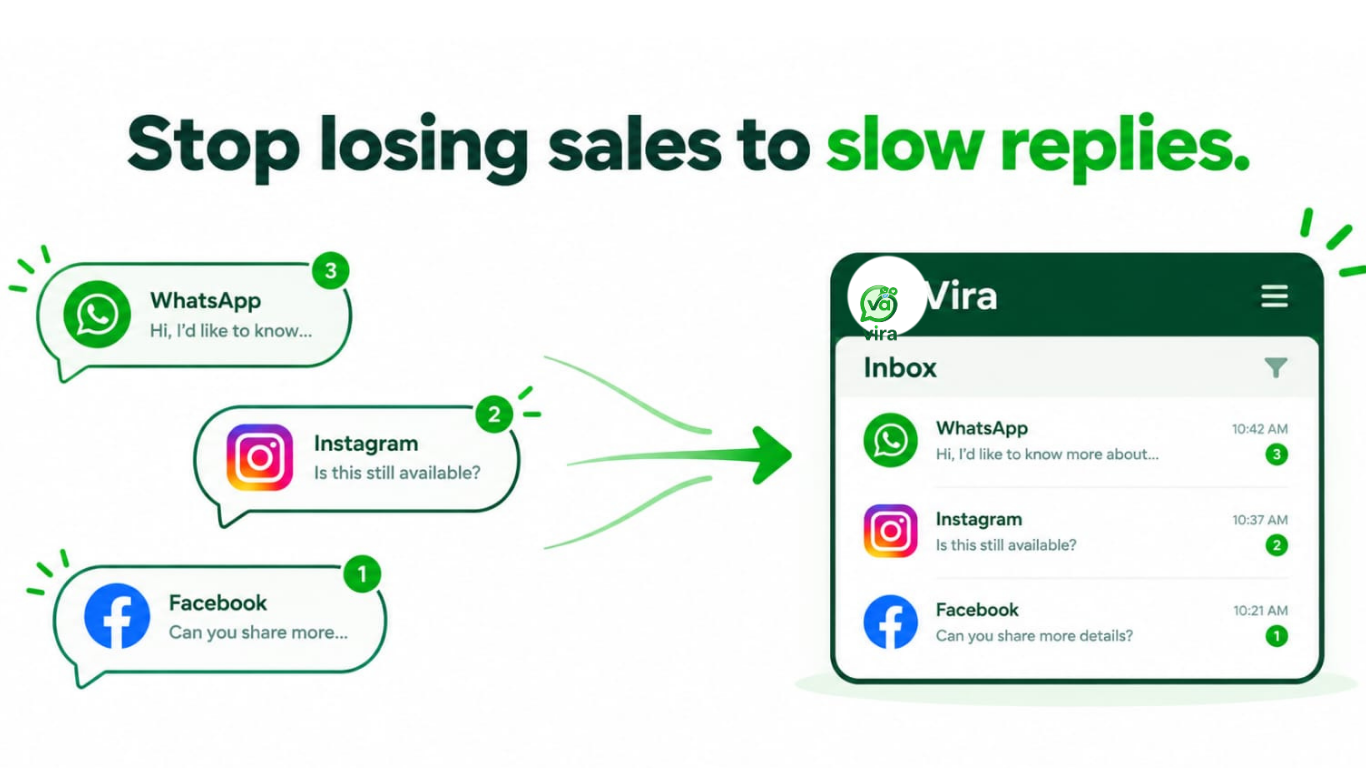
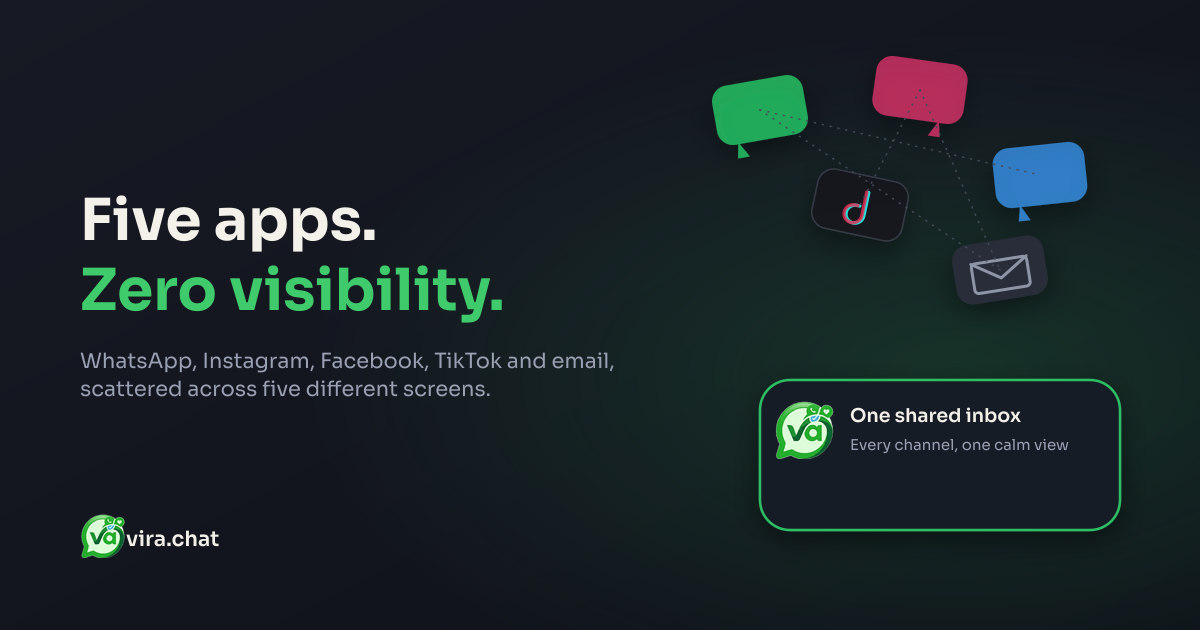
This is exactly the gap Vira was built to close. Instead of checking WhatsApp, Instagram, Facebook, and website chat separately, every conversation lands in one shared inbox your whole team can see. Smart routing makes sure nothing sits waiting for "whoever remembers to check," and AI-assisted replies catch the routine questions instantly, even outside working hours, so your unanswered-message rate doesn't have to be a mystery you rediscover every few months.
If your slowest channel turned out to be the one nobody's specifically responsible for, that's not a discipline problem. It's a structural one, and it's fixable in an afternoon, not a quarter.
Curious what your numbers would look like with everything in one place? Book a demo with Vira and see how a unified inbox changes the picture.